Ch. 35 - Diffraction
Giancoli Douglas - Physics for Scientists and Engineers 5th edition
Giancoli Douglas5th editionPhysics for Scientists and EngineersISBN: 9780137488179Not the one you use?Change textbook
Chapter 34, Problem 26

The nearest neighboring star to the Sun is about 4 light-years away. If a planet happened to be orbiting this star at an orbital radius equal to that of the Earth–Sun distance, what minimum diameter would an Earth-based telescope’s aperture have to be in order to obtain an image that resolved this star–planet system? Assume the light emitted by the star and planet has a wavelength of 550 nm.

Verified step by step guidance
1
Determine the angular separation between the star and the planet. Use the formula for angular separation: θ = s / d, where s is the physical separation between the star and the planet (equal to the Earth-Sun distance, 1 AU = 1.496 × 10^11 m), and d is the distance to the star (4 light-years = 4 × 9.461 × 10^15 m).
Calculate the minimum angular resolution required to resolve the star-planet system. The angular resolution of a telescope is given by the Rayleigh criterion: θ_min = 1.22 × (λ / D), where λ is the wavelength of light (550 nm = 550 × 10^-9 m) and D is the diameter of the telescope aperture. Rearrange this formula to solve for D: D = 1.22 × (λ / θ_min).
Substitute the value of θ_min (calculated in step 1) into the formula for D. This will give the minimum diameter of the telescope aperture required to resolve the star-planet system.
Ensure all units are consistent throughout the calculations. For example, convert light-years to meters and ensure the wavelength is in meters before substituting into the equations.
Interpret the result to understand the feasibility of building such a telescope. Consider whether the calculated aperture diameter is practical for Earth-based telescopes or if space-based telescopes might be required.

Verified video answer for a similar problem:

This video solution was recommended by our tutors as helpful for the problem above.
Video duration:
5m
Was this helpful?

Key Concepts

Here are the essential concepts you must grasp in order to answer the question correctly.

Resolution of Telescopes

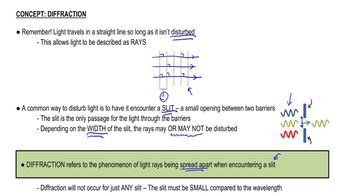
The resolution of a telescope refers to its ability to distinguish between two closely spaced objects. This is determined by the diffraction limit, which is influenced by the aperture size and the wavelength of light being observed. A larger aperture allows for better resolution, enabling the telescope to separate the light from the star and the planet in this scenario.
Recommended video:

Diffraction Limit

The diffraction limit is the fundamental limit to the resolution of optical systems due to the wave nature of light. It can be calculated using the formula θ = 1.22(λ/D), where θ is the angular resolution in radians, λ is the wavelength of light, and D is the diameter of the telescope's aperture. Understanding this concept is crucial for determining the minimum aperture size needed to resolve the star-planet system.
Recommended video:

Light-Year and Distance Measurement

A light-year is the distance that light travels in one year, approximately 9.46 trillion kilometers. In this question, the distance to the neighboring star is given as 4 light-years, which translates to a significant distance in astronomical terms. This measurement is essential for calculating the angular separation between the star and the planet, which directly impacts the required resolution of the telescope.
Recommended video:
Guided course
06:03
The Doppler Effect (Light)
Related Practice