
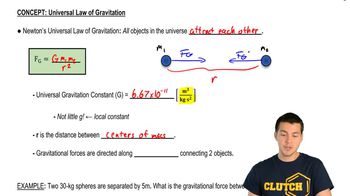
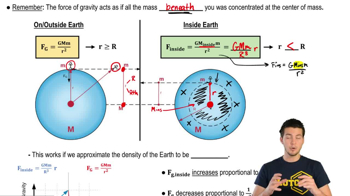
A uniform, spherical, shell has a radius of . Sketch a qualitative graph of the magnitude of the gravitational force this sphere exerts on a point mass m as a function of the distance of from the center of the sphere. Include the region from to .
A uniform, solid, 1000.0-kg sphere has a radius of 5.00 m. Find the gravitational force this sphere exerts on a 2.00-kg point mass placed at the following distances from the center of the sphere: (i) 5.01 m, (ii) 2.50 m.
Verified step by step guidance
Verified video answer for a similar problem:
Key Concepts
Newton's Law of Universal Gravitation
Shell Theorem
Gravitational Field Inside a Sphere
Consider the ringshaped body of Fig. E13.35. A particle with mass m is placed a distance x from the center of the ring, along the line through the center of the ring and perpendicular to its plane. (a) Calculate the gravitational potential energy U of this system. Take the potential energy to be zero when the two objects are far apart. (b) Show that your answer to part (a) reduces to the expected result when x is much larger than the radius a of the ring. (c) Use Fx = -dU/dx to find the magnitude and direction of the force on the particle (see Section 7.4). (d) Show that your answer to part (c) reduces to the expected result when x is much larger than a. (e) What are the values of U and Fx when x = 0? Explain why these results make sense.
A thin, uniform rod has length L and mass M. A small uniform sphere of mass m is placed a distance x from one end of the rod, along the axis of the rod (Fig. E13.34). Calculate the gravitational potential energy of the rod–sphere system. Take the potential energy to be zero when the rod and sphere are infinitely far apart. Show that your answer reduces to the expected result when x is much larger than L.
A thin, uniform rod has length L and mass M. A small uniform sphere of mass m is placed a distance x from one end of the rod, along the axis of the rod (Fig. E13.34). Use Fx = -dU/dx to find the magnitude and direction of the gravitational force exerted on the sphere by the rod (see Section 7.4). Show that your answer reduces to the expected result when x is much larger than L.
On October 15, 2001, a planet was discovered orbiting around the star HD 68988. Its orbital distance was measured to be 10.5 million kilometers from the center of the star, and its orbital period was estimated at 6.3 days. What is the mass of HD 68988? Express your answer in kilograms and in terms of our sun's mass.
A uniform, spherical, 1000.0-kg shell has a radius of 5.00 m. Find the gravitational force this shell exerts on a 2.00-kg point mass placed at the following distances from the center of the shell: (i) 5.01 m, (ii) 4.99 m, (iii) 2.72 m.
