
Textbook Question
Compute the torque developed by an industrial motor whose output is 150 kW at an angular speed of 4000 rev/min.

 Verified step by step guidance
 06:18
06:18
 08:55
08:55 12:12
12:12Compute the torque developed by an industrial motor whose output is 150 kW at an angular speed of 4000 rev/min.
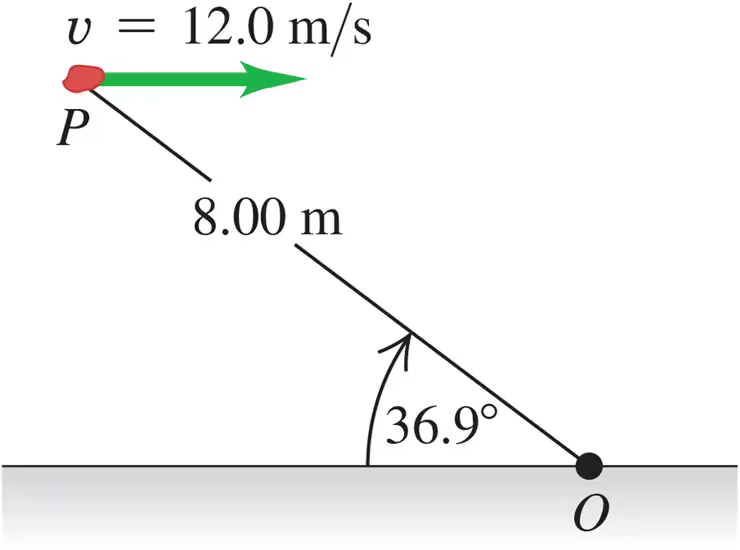
A 2.00-kg rock has a horizontal velocity of magnitude 12.0 m/s when it is at point P in Fig. E10.35. At this instant, what are the magnitude and direction of its angular momentum relative to point O?
A woman with mass 50 kg is standing on the rim of a large disk that is rotating at 0.80 rev/s about an axis through its center. The disk has mass 110 kg and radius 4.0 m. Calculate the magnitude of the total angular momentum of the woman–disk system. (Assume that you can treat the woman as a point.)
An airplane propeller is 2.08 m in length (from tip to tip) and has a mass of 117 kg. When the airplane's engine is first started, it applies a constant torque of 1950 Nm to the propeller, which starts from rest. What is the instantaneous power output of the motor at the instant that the propeller has turned through 5.00 revolutions?
Calculate the magnitude of the angular momentum of the earth in a circular orbit around the sun. Is it reasonable to model it as a particle? Consult Appendix E and the astronomical data in Appendix F
A hollow, thin-walled sphere of mass and diameter is rotating about an axle through its center. The angle (in radians) through which it turns as a function of time (in seconds) is given by , where A has numerical value and B has numerical value . What are the units of the constants A and B?