Ch 01: Concepts of Motion
Knight Calc - Physics for Scientists and Engineers 5th Edition
Knight Calc5th EditionPhysics for Scientists and EngineersISBN: 9780137344796Not the one you use?Change textbook
Chapter 1, Problem 55

A 5.4 cm diameter cylinder has a length of 12.5 cm. What is the cylinder's volume in basic SI units?

Verified step by step guidance
1
Step 1: Recall the formula for the volume of a cylinder, which is given by \( V = \pi r^2 h \), where \( r \) is the radius and \( h \) is the height (or length) of the cylinder.
Step 2: Convert the given diameter of the cylinder (5.4 cm) into the radius by dividing it by 2. This gives \( r = \frac{5.4}{2} \) cm.
Step 3: Convert the radius and the length of the cylinder from centimeters to meters, as SI units require measurements in meters. Use the conversion factor \( 1 \, \text{cm} = 0.01 \; \text{m} \). For the radius, \( r \, \text{(in meters)} = r \, \text{(in cm)} \times 0.01 \). Similarly, for the length, \( h \, \text{(in meters)} = h \, \text{(in cm)} \times 0.01 \).
Step 4: Substitute the converted values of \( r \) and \( h \) into the formula \( V = \pi r^2 h \). This involves squaring the radius \( r \), multiplying it by \( \pi \), and then multiplying by the length \( h \).
Step 5: The result will give the volume of the cylinder in cubic meters (\( \text{m}^3 \)), which is the SI unit for volume.

Verified video answer for a similar problem:

This video solution was recommended by our tutors as helpful for the problem above.
Video duration:
2m
Was this helpful?

Key Concepts

Here are the essential concepts you must grasp in order to answer the question correctly.

Volume of a Cylinder

The volume of a cylinder can be calculated using the formula V = πr²h, where r is the radius and h is the height (or length) of the cylinder. The radius is half the diameter, so for a cylinder with a diameter of 5.4 cm, the radius would be 2.7 cm. This formula is essential for determining the amount of space the cylinder occupies.
Recommended video:
Guided course
05:21
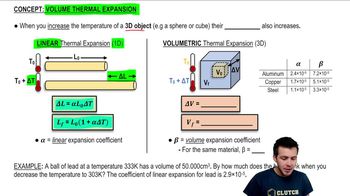
Volume Thermal Expansion

SI Units

The International System of Units (SI) is the standard system of measurement used in science and engineering. In this context, volume is typically expressed in cubic meters (m³). To convert from cubic centimeters (cm³) to cubic meters, one must divide by 1,000,000, as 1 m³ equals 1,000,000 cm³. Understanding SI units is crucial for ensuring accurate calculations and comparisons.
Recommended video:
Guided course
03:18
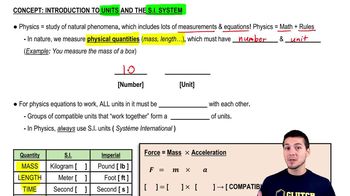
Introduction to Units & the SI System

Pi (π)

Pi (π) is a mathematical constant approximately equal to 3.14159, representing the ratio of a circle's circumference to its diameter. It is a critical component in the volume formula for cylinders, as it accounts for the circular base of the cylinder. Recognizing the role of π in geometric calculations is vital for solving problems involving circular shapes.
Recommended video: