
Ch 02: Kinematics in One Dimension
Knight Calc - Physics for Scientists and Engineers 5th Edition
Knight Calc5th EditionPhysics for Scientists and EngineersISBN: 9780137344796Not the one you use?Change textbook
Chapter 2, Problem 53a

Find an expression for the minimum stopping distance dstop of a car traveling at speed v0 if the driver's reaction time is Treact and the magnitude of the acceleration during maximum braking is a constant abrake.

Verified step by step guidance
1
Identify the two phases of the car's motion: (1) the reaction phase, where the car travels at constant speed during the driver's reaction time, and (2) the braking phase, where the car decelerates uniformly to a stop.
For the reaction phase, calculate the distance traveled during the reaction time \( T_{\text{react}} \) using the formula \( d_{\text{react}} = v_0 \cdot T_{\text{react}} \), where \( v_0 \) is the initial speed of the car.
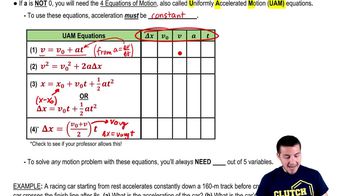
For the braking phase, use the kinematic equation \( v_f^2 = v_0^2 + 2a_{\text{brake}}d_{\text{brake}} \), where \( v_f = 0 \) (final velocity), \( a_{\text{brake}} \) is the constant deceleration, and \( d_{\text{brake}} \) is the stopping distance during braking. Rearrange to find \( d_{\text{brake}} = \frac{-v_0^2}{2a_{\text{brake}}} \).
Combine the distances from both phases to find the total stopping distance: \( d_{\text{stop}} = d_{\text{react}} + d_{\text{brake}} \). Substituting the expressions, \( d_{\text{stop}} = v_0 \cdot T_{\text{react}} + \frac{-v_0^2}{2a_{\text{brake}}} \).
Simplify the expression to obtain the final formula for the minimum stopping distance: \( d_{\text{stop}} = v_0 \cdot T_{\text{react}} + \frac{v_0^2}{2a_{\text{brake}}} \). This formula accounts for both the reaction time and the braking phase.

Verified video answer for a similar problem:

This video solution was recommended by our tutors as helpful for the problem above.
Video duration:
6m
Was this helpful?

Key Concepts

Here are the essential concepts you must grasp in order to answer the question correctly.

Kinematics

Kinematics is the branch of physics that describes the motion of objects without considering the forces that cause the motion. It involves concepts such as displacement, velocity, and acceleration. In this context, understanding kinematics is essential to analyze how a car's speed changes over time, particularly during braking.
Recommended video:
Guided course
08:25
Kinematics Equations

Acceleration

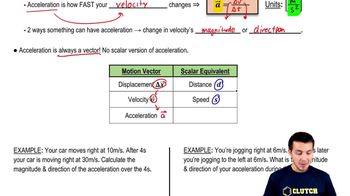
Acceleration is the rate of change of velocity of an object with respect to time. It can be positive (speeding up) or negative (slowing down, also known as deceleration). In the problem, the constant acceleration during maximum braking, denoted as a₆ᵣₐₖₑ, is crucial for determining how quickly the car can stop from its initial speed v₀.
Recommended video:
Guided course
05:47
Intro to Acceleration

Reaction Time

Reaction time is the delay between the perception of a stimulus and the initiation of a response. In driving, it refers to the time it takes for a driver to react to a situation, such as pressing the brakes. The driver's reaction time, Tᵣₑₐ꜀ₜ, affects the total stopping distance, as it contributes to the distance traveled before braking begins.
Recommended video:
Guided course
08:01
Newton's Third Law & Action-Reaction Pairs
Related Practice
Textbook Question

A cheetah spots a Thomson's gazelle, its preferred prey, and leaps into action, quickly accelerating to its top speed of 30 m/s, the highest of any land animal. However, a cheetah can maintain this extreme speed for only 15 s before having to let up. The cheetah is 170 m from the gazelle as it reaches top speed, and the gazelle sees the cheetah at just this instant. With negligible reaction time, the gazelle heads directly away from the cheetah, accelerating at 4.6 m/s² for 5.0 s, then running at constant speed. Does the gazelle escape? If so, by what distance is the gazelle in front when the cheetah gives up?

1
views
Textbook Question

A 200 kg weather rocket is loaded with 100 kg of fuel and fired straight up. It accelerates upward at 30 m/s² for 30 s, then runs out of fuel. Ignore any air resistance effects. What is the rocket's maximum altitude?

1
views
Textbook Question

You're driving down the highway late one night at 20 m/s when a deer steps onto the road 35 m in front of you. Your reaction time before stepping on the brakes is 0.50 s, and the maximum deceleration of your car is 10 m/s². How much distance is between you and the deer when you come to a stop?

1
views
Textbook Question

A lead ball is dropped into a lake from a diving board 5.0 m above the water. After entering the water, it sinks to the bottom with a constant velocity equal to the velocity with which it hit the water. The ball reaches the bottom 3.0 s after it is released. How deep is the lake?

2
views
Textbook Question

A car starts from rest at a stop sign. It accelerates at 4.0 m/s² for 6.0 s, coasts for 2.0 s, and then slows down at a rate of 3.0 m/s² for the next stop sign. How far apart are the stop signs?

2
views
Textbook Question

A 1000 kg weather rocket is launched straight up. The rocket motor provides a constant acceleration for 16 s, then the motor stops. The rocket altitude 20 s after launch is 5100 m. You can ignore any effects of air resistance. What was the rocket's acceleration during the first 16 s?

1
views