
Ch 23: Electric Potential
Young & Freedman Calc - University Physics 14th Edition
Young & Freedman Calc14th EditionUniversity PhysicsISBN: 9780321973610Not the one you use?Change textbook
Chapter 23, Problem 36a

Two large, parallel conducting plates carrying op­posite charges of equal magnitude are separated by 2.202.20 cm. If the surface charge density for each plate has magnitude 47.047.0 nC/m2, what is the magnitude of EE in the region between the plates?

Verified step by step guidance
1
Understand that the electric field (E) between two parallel plates with opposite charges can be calculated using the formula for the electric field due to a single plate: E = σ / (2ε₀), where σ is the surface charge density and ε₀ is the permittivity of free space.
Since the plates have opposite charges, the electric fields due to each plate add up in the region between them. Therefore, the total electric field E between the plates is given by E = σ / ε₀.
Identify the given values: the surface charge density σ is 47.0 nC/m², which needs to be converted to C/m² by multiplying by 10⁻⁹, and the permittivity of free space ε₀ is approximately 8.85 x 10⁻¹² C²/(N·m²).
Substitute the values into the formula: E = (47.0 x 10⁻⁹ C/m²) / (8.85 x 10⁻¹² C²/(N·m²)).
Perform the division to find the magnitude of the electric field E in the region between the plates.

Verified video answer for a similar problem:

This video solution was recommended by our tutors as helpful for the problem above.
Video duration:
1m
Was this helpful?

Key Concepts

Here are the essential concepts you must grasp in order to answer the question correctly.

Electric Field

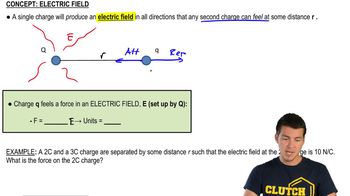
The electric field (E) is a vector field that represents the force per unit charge exerted on a positive test charge placed in the field. It is measured in newtons per coulomb (N/C) and is crucial for understanding the interaction between charged objects. In this scenario, the electric field is uniform between the parallel plates due to their large size and equal but opposite charges.
Recommended video:
Guided course
03:16
Intro to Electric Fields

Surface Charge Density

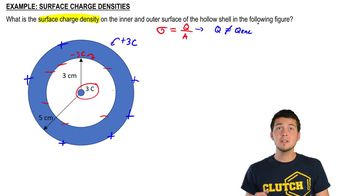
Surface charge density (σ) is the amount of electric charge per unit area on a surface, measured in coulombs per square meter (C/m²). It is a key factor in determining the electric field between charged plates. For parallel plates, the electric field magnitude can be calculated using the surface charge density and the permittivity of free space (ε₀).
Recommended video:
Guided course
04:03
Surface Charge Density

Gauss's Law

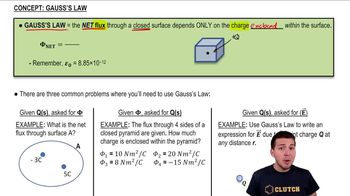
Gauss's Law relates the electric flux through a closed surface to the charge enclosed by that surface. It is expressed as Φ = Q/ε₀, where Φ is the electric flux, Q is the enclosed charge, and ε₀ is the permittivity of free space. For parallel plates, Gauss's Law helps derive the electric field as E = σ/ε₀, assuming a uniform field between the plates.
Recommended video:
Related Practice
Textbook Question

A very long insulating cylinder of charge of radius 2.502.50 cm carries a uniform linear density of 15.015.0 nC/m. If you put one probe of a voltmeter at the surface, how far from the surface must the other probe be placed so that the voltmeter reads 175175 V?

12
views
Textbook Question

An infinitely long line of charge has linear charge den­sity 5.00×10125.00\(\times\)10^{-12} C/m. A proton (mass 1.67×10271.67\(\times\)10^{-27} kg, charge +1.60×10¹⁹+1.60\(\times\)10^{-19} C) is 18.018.0 cm from the line and moving directly toward the line at 3.50×1033.50\(\times\)10^3 m/s. Calculate the proton's initial kinetic energy.

Textbook Question

Certain sharks can detect an electric field as weak as 1.01.0 μμV/m. To grasp how weak this field is, if you wanted to produce it between two parallel metal plates by connecting an ordinary 1.51.5­V AA battery across these plates, how far apart would the plates have to be?

2
views
Textbook Question

Two large, parallel conducting plates carrying op­posite charges of equal magnitude are separated by 2.202.20 cm. What is the potential difference between the two plates?

Textbook Question

Two large, parallel conducting plates carrying op­posite charges of equal magnitude are separated by 2.202.20 cm. The surface charge density for each plate has magnitude 47.047.0 nC/m^2. If the separation between the plates is doubled while the surface charge density is kept constant at the given value, what happens to the magnitude of the electric field and to the po­tential difference?

1
views
Textbook Question

An infinitely long line of charge has linear charge den­sity 5.00×10125.00\(\times\)10^{-12} C/m. A proton (mass 1.67×10271.67\(\times\)10^{-27} kg, charge +1.60×10¹⁹+1.60\(\times\)10^{-19} C) is 18.018.0 cm from the line and moving directly toward the line at 3.50×1033.50\(\times\)10^3 m/s. How close does the proton get to the line of charge?

9
views