Ch 03: Vectors and Coordinate Systems
Knight Calc - Physics for Scientists and Engineers 5th Edition
Knight Calc5th EditionPhysics for Scientists and EngineersISBN: 9780137344796Not the one you use?Change textbook
Chapter 3, Problem 2b

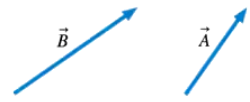
Trace the vectors in FIGURE EX3.1 onto your paper. Then find AB\(\overrightarrow{A}\)-\(\overrightarrow{B}\).

Verified step by step guidance
1
Step 1: Understand the problem. You are tasked with finding the vector subtraction A - B. This involves reversing the direction of vector B and then adding it to vector A.
Step 2: Reverse the direction of vector B. To subtract vector B from vector A, you need to first reverse the direction of vector B. This means flipping vector B so that it points in the opposite direction while maintaining its magnitude.
Step 3: Place the tail of the reversed vector B at the head of vector A. This is the graphical method of vector addition, where you align the vectors tip-to-tail.
Step 4: Draw the resultant vector. The resultant vector (A - B) is drawn from the tail of vector A to the tip of the reversed vector B.
Step 5: If needed, calculate the magnitude and direction of the resultant vector using trigonometry or the Pythagorean theorem, depending on the given components or angles of vectors A and B.

Verified video answer for a similar problem:

This video solution was recommended by our tutors as helpful for the problem above.
Video duration:
3m
Was this helpful?

Key Concepts

Here are the essential concepts you must grasp in order to answer the question correctly.

Vector Subtraction

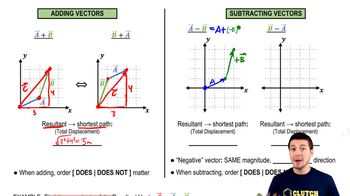
Vector subtraction involves finding the difference between two vectors, A and B, resulting in a new vector, A - B. This is done by reversing the direction of vector B and then adding it to vector A. The resultant vector represents the change in position or direction from the tip of vector B to the tip of vector A.
Recommended video:
Guided course
05:58
Subtracting Vectors Graphically

Vector Representation

Vectors are represented graphically as arrows, where the length indicates the magnitude and the direction indicates the vector's direction. In the context of the question, vectors A and B are shown with specific orientations and lengths, which are crucial for accurately performing vector operations like subtraction.
Recommended video:
Guided course
06:44
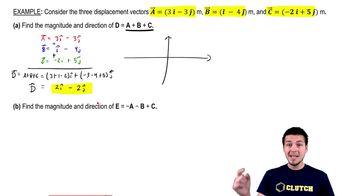
Adding 3 Vectors in Unit Vector Notation

Graphical Addition of Vectors

Graphical addition of vectors involves placing the tail of one vector at the tip of another to find the resultant vector. This method is essential for visualizing vector operations, such as subtraction, where the vector to be subtracted is inverted and then added to the original vector, allowing for a clear understanding of the resultant direction and magnitude.
Recommended video:
Guided course
05:58
Subtracting Vectors Graphically