Ch 01: Units, Physical Quantities & Vectors
Young & Freedman Calc - University Physics 14th Edition
Young & Freedman Calc14th EditionUniversity PhysicsISBN: 9780321973610Not the one you use?Change textbook
Chapter 1, Problem 35b

Vector A is 2.80 cm long and is 60.0° above the x-axis in the first quadrant. Vector B is 1.90 cm long and is 60.0° below the x-axis in the fourth quadrant (Fig. E1.35). Use components to find the magnitude and direction of A - B In each case, sketch the vector addition or subtraction and show that your numerical answers are in qualitative agreement with your sketch.


Vector A (2.80 cm) at 60° above x-axis and B (1.90 cm) at 60° below x-axis.

Verified step by step guidance
1
First, resolve Vector A into its components. The x-component of Vector A is given by A_x = A * cos(60°) and the y-component by A_y = A * sin(60°). Substitute A = 2.80 cm to find A_x and A_y.
Next, resolve Vector B into its components. The x-component of Vector B is B_x = B * cos(60°) and the y-component is B_y = -B * sin(60°) because it is below the x-axis. Substitute B = 1.90 cm to find B_x and B_y.
To find the components of A - B, subtract the components of B from A. So, (A - B)_x = A_x - B_x and (A - B)_y = A_y - B_y.
Calculate the magnitude of the resultant vector A - B using the Pythagorean theorem: |A - B| = sqrt((A - B)_x^2 + (A - B)_y^2).
Determine the direction of the resultant vector A - B by calculating the angle θ with respect to the x-axis using the tangent function: θ = arctan((A - B)_y / (A - B)_x).

Verified video answer for a similar problem:

This video solution was recommended by our tutors as helpful for the problem above.
Video duration:
8m
Was this helpful?

Key Concepts

Here are the essential concepts you must grasp in order to answer the question correctly.

Vector Components

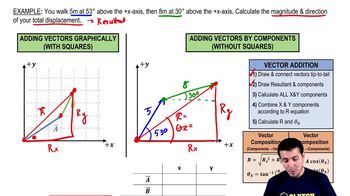
Vectors can be broken down into their components along the axes of a coordinate system. For a vector at an angle, the horizontal (x) and vertical (y) components can be calculated using trigonometric functions: the x-component is found using cosine, and the y-component using sine. This breakdown is essential for performing vector addition or subtraction, as it allows for the manipulation of each component separately.
Recommended video:
Guided course
07:30
Vector Addition By Components

Vector Subtraction

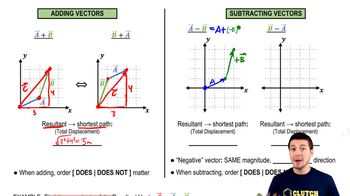
Vector subtraction involves finding the resultant vector when one vector is taken away from another. This can be visualized as adding a negative vector, which is the same as reversing the direction of the vector being subtracted. Mathematically, if A and B are vectors, then A - B can be computed by subtracting the components of B from those of A, resulting in a new vector that represents the difference.
Recommended video:
Guided course
05:58
Subtracting Vectors Graphically

Magnitude and Direction

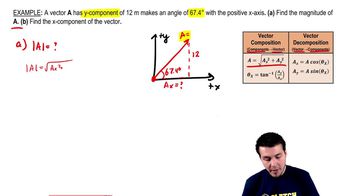
The magnitude of a vector is its length, while the direction indicates the angle it makes with a reference axis. To find the magnitude of a resultant vector from its components, the Pythagorean theorem is used. The direction can be determined using the arctangent function, which relates the components to the angle. Understanding both magnitude and direction is crucial for accurately representing and interpreting vector quantities.
Recommended video:
Guided course
03:59
Calculating Magnitude & Components of a Vector