Ch 27: Current and Resistance
Knight Calc - Physics for Scientists and Engineers 5th Edition
Knight Calc5th EditionPhysics for Scientists and EngineersISBN: 9780137344796Not the one you use?Change textbook
Chapter 27, Problem 14

The current in a 2.0 mm x 2.0 mm square aluminum wire is 2.5 A. What are (a) the current density and (b) the electron drift speed?

Verified step by step guidance
1
To calculate the current density \( J \), use the formula \( J = \frac{I}{A} \), where \( I \) is the current and \( A \) is the cross-sectional area of the wire. First, calculate the area of the square cross-section: \( A = \text{side}^2 = (2.0 \times 10^{-3} \ \text{m})^2 \).
Substitute the given current \( I = 2.5 \ \text{A} \) and the calculated area \( A \) into the formula \( J = \frac{I}{A} \) to find the current density.
To calculate the electron drift speed \( v_d \), use the formula \( v_d = \frac{I}{n e A} \), where \( n \) is the number density of electrons, \( e \) is the elementary charge \( (1.6 \times 10^{-19} \ \text{C}) \), and \( A \) is the cross-sectional area of the wire.
For aluminum, the number density of conduction electrons \( n \) is approximately \( 6.02 \times 10^{28} \ \text{electrons/m}^3 \). Substitute \( I = 2.5 \ \text{A} \), \( n = 6.02 \times 10^{28} \ \text{electrons/m}^3 \), \( e = 1.6 \times 10^{-19} \ \text{C} \), and the previously calculated \( A \) into the formula \( v_d = \frac{I}{n e A} \).
Simplify the expression to find the electron drift speed \( v_d \). Note that the drift speed is typically very small, as the number density of electrons is very large.

Verified video answer for a similar problem:

This video solution was recommended by our tutors as helpful for the problem above.
Was this helpful?

Key Concepts

Here are the essential concepts you must grasp in order to answer the question correctly.

Current Density

Current density is defined as the amount of electric current flowing per unit area of a conductor. It is calculated using the formula J = I/A, where J is the current density, I is the current, and A is the cross-sectional area. In this case, the area of the square aluminum wire can be determined by squaring its side length, allowing for the calculation of current density in units of A/m².
Recommended video:
Guided course
8:13
Intro to Density

Electron Drift Speed

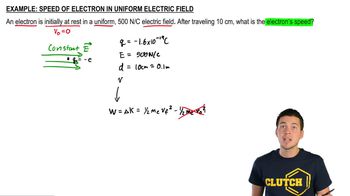
Electron drift speed refers to the average velocity that a charge carrier, such as an electron, attains due to an electric field. It is calculated using the formula v_d = J/(nq), where v_d is the drift speed, J is the current density, n is the number density of charge carriers, and q is the charge of an electron. Understanding this concept is crucial for determining how quickly electrons move through the conductor under the influence of the applied current.
Recommended video:
Guided course
05:32
Speed of Electron in Electric Field

Aluminum Properties

Aluminum is a conductive material with specific properties that affect its electrical behavior, including resistivity and the number density of free electrons. The resistivity of aluminum is relatively low, making it an efficient conductor. Knowing the properties of aluminum helps in calculating both current density and electron drift speed, as these calculations depend on the material's characteristics and the number of charge carriers available.
Recommended video:
Guided course
04:06
Pouring Hot Water in an Aluminum Cup