Ch 16: Sound & Hearing
Young & Freedman Calc - University Physics 14th Edition
Young & Freedman Calc14th EditionUniversity PhysicsISBN: 9780321973610Not the one you use?Change textbook
Chapter 16, Problem 21

A baby's mouth is 30 cm from her father's ear and 1.50 m from her mother's ear. What is the difference between the sound intensity levels heard by the father and by the mother?

Verified step by step guidance
1
First, understand that sound intensity level is measured in decibels (dB) and is related to the intensity of sound, which decreases with distance from the source according to the inverse square law.
The formula for sound intensity level in decibels is given by: L=10logII0, where I is the intensity of the sound and I0 is the reference intensity.
To find the intensity at each ear, use the inverse square law: I=P4πr2, where P is the power of the sound source and r is the distance from the source.
Calculate the intensity at the father's ear using the distance of 30 cm (0.30 m) and at the mother's ear using the distance of 1.50 m.
Finally, find the difference in sound intensity levels by calculating the decibel levels for each intensity and subtracting them: ΔL=Lfather-Lmother.

Verified video answer for a similar problem:

This video solution was recommended by our tutors as helpful for the problem above.
Video duration:
3m
Was this helpful?

Key Concepts

Here are the essential concepts you must grasp in order to answer the question correctly.

Sound Intensity

Sound intensity refers to the power per unit area carried by a sound wave. It is measured in watts per square meter (W/m²) and is a crucial factor in determining how loud a sound is perceived. The intensity decreases with distance from the source, following the inverse square law, meaning it diminishes as the distance increases.
Recommended video:
Guided course
04:25
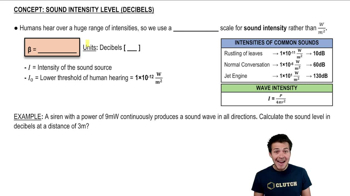
Sound Intensity Level and the Decibel Scale

Inverse Square Law

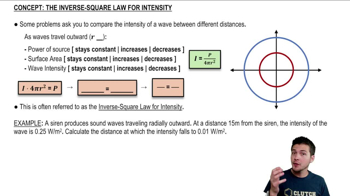
The inverse square law states that the intensity of a sound wave is inversely proportional to the square of the distance from the source. This means that as you move away from the sound source, the intensity decreases rapidly. For example, doubling the distance from the source results in a quarter of the original intensity.
Recommended video:
Guided course
05:26
The Inverse-Square Law for Intensity

Decibel Scale

The decibel scale is a logarithmic scale used to measure sound intensity levels. It allows for a more manageable representation of the wide range of sound intensities humans can perceive. A difference of 10 dB represents a tenfold change in intensity, making it easier to compare sound levels at different distances from the source.
Recommended video:
Guided course
04:25
Sound Intensity Level and the Decibel Scale