

Ch 15: Oscillations
Knight Calc - Physics for Scientists and Engineers 5th Edition
Knight Calc5th EditionPhysics for Scientists and EngineersISBN: 9780137344796Not the one you use?Change textbook
Chapter 15, Problem 3

An object in SHM oscillates with a period of 4.0 s and an amplitude of 10 cm. How long does the object take to move from x = 0.0 cm to x = 6.0 cm?

Verified step by step guidance
1
Step 1: Recall the equation for the position of an object in simple harmonic motion (SHM): x=Asin(ωt), where x is the position, A is the amplitude, ω is the angular frequency, and t is the time.
Step 2: Calculate the angular frequency ω using the relationship ω=2π/T, where T is the period. Substitute T=4.0 s into the equation.
Step 3: Rearrange the SHM equation to solve for time t: t=sin-1(xA)ω. Substitute x=6.0 cm and A=10 cm into the equation.
Step 4: Simplify the argument of the sine inverse function: xA=6.010=0.6. Then calculate sin-1(0.6).
Step 5: Divide the result of sin-1(0.6) by the angular frequency ω to find the time t. This gives the time it takes for the object to move from x=0.0 cm to x=6.0 cm.

Verified video answer for a similar problem:

This video solution was recommended by our tutors as helpful for the problem above.
Video duration:
5m
Was this helpful?

Key Concepts

Here are the essential concepts you must grasp in order to answer the question correctly.

Simple Harmonic Motion (SHM)

Simple Harmonic Motion is a type of periodic motion where an object oscillates around an equilibrium position. The motion is characterized by a restoring force proportional to the displacement from the equilibrium, leading to sinusoidal motion. Key parameters include amplitude, period, and frequency, which define the motion's characteristics.
Recommended video:
Guided course
07:52
Simple Harmonic Motion of Pendulums

Amplitude and Period

Amplitude is the maximum displacement of an object from its equilibrium position in SHM, while the period is the time taken to complete one full cycle of motion. In this case, the amplitude is 10 cm, indicating the maximum distance from the center, and the period of 4.0 s defines how long it takes to return to the same position in the cycle.
Recommended video:
Guided course
06:28
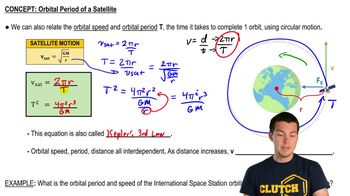
Satellite Period

Position in SHM

The position of an object in SHM can be described using the equation x(t) = A cos(ωt + φ), where A is the amplitude, ω is the angular frequency, and φ is the phase constant. To find the time taken to move from one position to another, we can calculate the corresponding angles and use the period to determine the time interval.
Recommended video:
Guided course
14:03
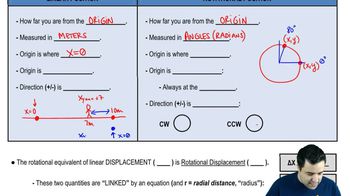
Rotational Position & Displacement