Ch 07: Potential Energy & Conservation
Young & Freedman Calc - University Physics 14th Edition
Young & Freedman Calc14th EditionUniversity PhysicsISBN: 9780321973610Not the one you use?Change textbook
Chapter 7, Problem 21b

A spring of negligible mass has force constant k=1600k = 1600 N/m. You place the spring vertically with one end on the floor. You then drop a 1.201.20-kg book onto it from a height of 0.8000.800 m above the top of the spring. Find the maximum distance the spring will be compressed.

Verified step by step guidance
1
Step 1: Identify the energy transformations involved. The book initially has gravitational potential energy due to its height above the spring. As the book falls, this energy is converted into kinetic energy, and finally, when the book compresses the spring, the energy is stored as elastic potential energy in the spring.
Step 2: Write the equation for conservation of energy. The total mechanical energy is conserved, so the initial gravitational potential energy of the book is equal to the elastic potential energy stored in the spring at maximum compression. Use the formula for gravitational potential energy, \( E_{g} = mgh \), and elastic potential energy, \( E_{s} = \frac{1}{2}kx^2 \), where \( x \) is the compression distance.
Step 3: Substitute the given values into the gravitational potential energy formula. The mass of the book \( m \) is 1.20 kg, the height \( h \) is 0.800 m, and the acceleration due to gravity \( g \) is approximately 9.8 m/s². Calculate \( E_{g} \).
Step 4: Set \( E_{g} \) equal to \( E_{s} \) to find the compression distance \( x \). Rearrange the elastic potential energy formula \( \frac{1}{2}kx^2 = mgh \) to solve for \( x \). Substitute \( k = 1600 \) N/m and the calculated \( E_{g} \) into the equation.
Step 5: Solve for \( x \) algebraically. Take the square root of both sides after isolating \( x^2 \). This will give the maximum compression distance of the spring.

Verified video answer for a similar problem:

This video solution was recommended by our tutors as helpful for the problem above.
Video duration:
8m
Was this helpful?

Key Concepts

Here are the essential concepts you must grasp in order to answer the question correctly.

Hooke's Law

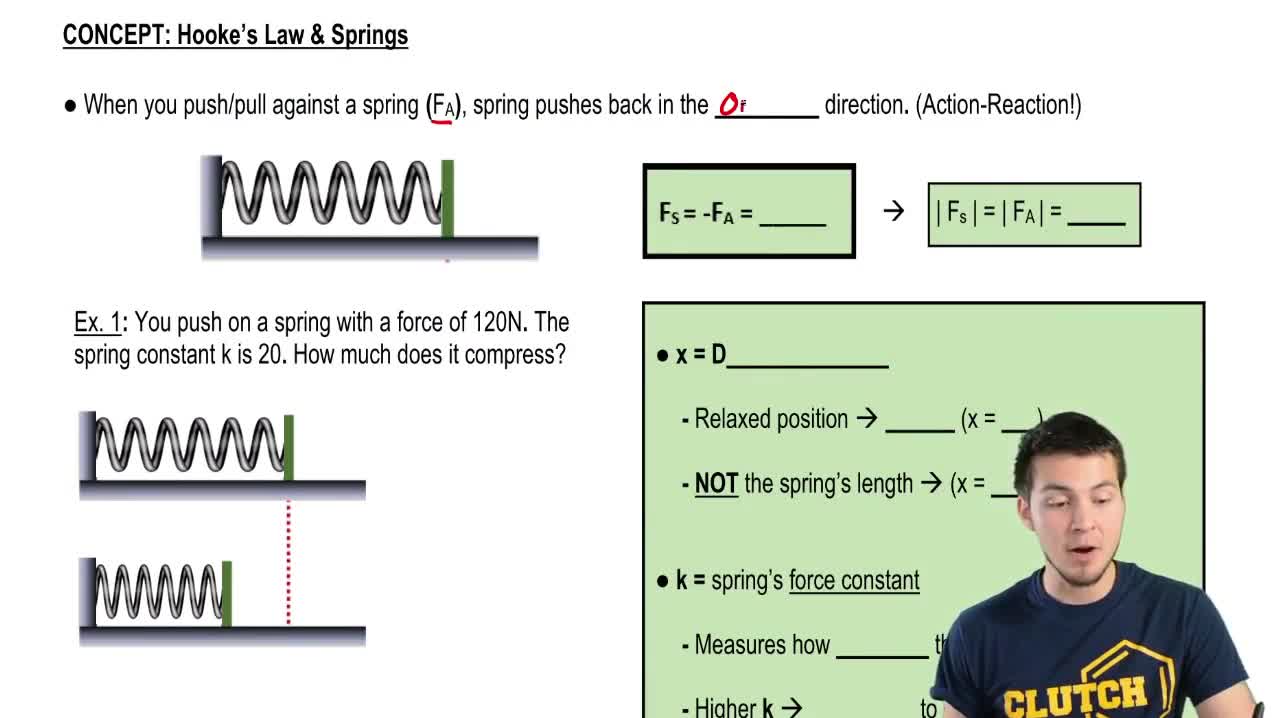
Hooke's Law states that the force exerted by a spring is directly proportional to its displacement from the equilibrium position, expressed as F = -kx, where F is the force, k is the spring constant, and x is the displacement. This principle is essential for understanding how the spring will behave when compressed by the weight of the book.
Recommended video:
Guided course
05:27
Spring Force (Hooke's Law)

Conservation of Energy

The principle of conservation of energy states that energy cannot be created or destroyed, only transformed from one form to another. In this scenario, the gravitational potential energy of the book when dropped is converted into elastic potential energy stored in the spring when it is compressed, allowing us to calculate the maximum compression.
Recommended video:
Guided course
06:24
Conservation Of Mechanical Energy

Gravitational Potential Energy

Gravitational potential energy (PE) is the energy an object possesses due to its position in a gravitational field, calculated as PE = mgh, where m is mass, g is the acceleration due to gravity, and h is the height above a reference point. This energy is crucial for determining how much energy is available to compress the spring when the book is dropped.
Recommended video:
Guided course
06:35
Gravitational Potential Energy