Ch 01: Concepts of Motion
Knight Calc - Physics for Scientists and Engineers 5th Edition
Knight Calc5th EditionPhysics for Scientists and EngineersISBN: 9780137344796Not the one you use?Change textbook
Chapter 1, Problem 49c

Problems 49, 50, 51, and 52 show a partial motion diagram. For each: Draw a pictorial representation for your problem.

Verified step by step guidance
1
Understand the concept of a motion diagram: A motion diagram is a series of images or dots that represent the position of an object at equal time intervals. It helps visualize the motion of an object, such as whether it is speeding up, slowing down, or moving at a constant velocity.
Identify the type of motion depicted in the partial motion diagram: Look at the spacing between the dots. If the spacing increases, the object is accelerating. If the spacing decreases, the object is decelerating. If the spacing is uniform, the object is moving at a constant velocity.
Draw a coordinate system for the pictorial representation: Choose an appropriate origin and axes (e.g., horizontal for motion along a straight line or vertical for free-fall motion). Label the axes with position and time as needed.
Sketch the object's position at different time intervals: Use the information from the motion diagram to plot the object's position on the coordinate system. Ensure the spacing between points reflects the motion (e.g., increasing spacing for acceleration).
Add additional details to the pictorial representation: Include velocity vectors (arrows) to indicate the direction and relative magnitude of the object's velocity at each point. If applicable, also include acceleration vectors to show the direction of acceleration.

Verified video answer for a similar problem:

This video solution was recommended by our tutors as helpful for the problem above.
Video duration:
2m
Was this helpful?

Key Concepts

Here are the essential concepts you must grasp in order to answer the question correctly.

Motion Diagrams

Motion diagrams are visual representations that illustrate the position of an object at various points in time. They typically consist of a series of dots or arrows that indicate the object's trajectory and velocity. Understanding motion diagrams is essential for analyzing the kinematics of an object, as they help visualize how an object moves through space over time.
Recommended video:
Guided course
08:07
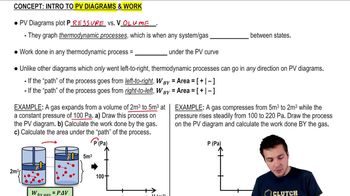
Work and PV Diagrams

Pictorial Representation

A pictorial representation is a visual depiction that conveys information about a physical situation or problem. In physics, this often includes drawings or sketches that illustrate forces, motion, and other relevant factors. Creating accurate pictorial representations is crucial for problem-solving, as they help clarify the relationships between different elements in a scenario.
Recommended video:
Guided course
04:25
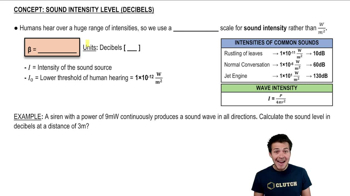
Sound Intensity Level and the Decibel Scale

Kinematics

Kinematics is the branch of physics that deals with the motion of objects without considering the forces that cause the motion. It involves concepts such as displacement, velocity, and acceleration. A solid understanding of kinematics is necessary for interpreting motion diagrams and creating pictorial representations, as it provides the foundational principles that describe how objects move.
Recommended video:
Guided course
08:25
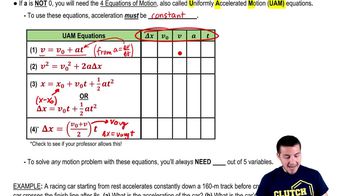
Kinematics Equations