
Ch 11: Equilibrium & Elasticity
Young & Freedman Calc - University Physics 14th Edition
Young & Freedman Calc14th EditionUniversity PhysicsISBN: 9780321973610Not the one you use?Change textbook
Chapter 11, Problem 14a

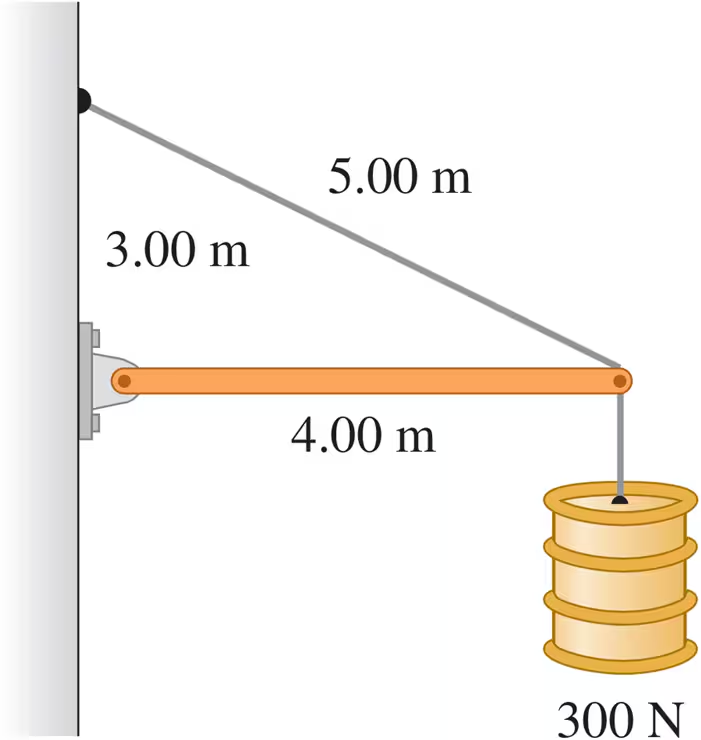
The horizontal beam in Fig. E11.14 weighs 190 N, and its center of gravity is at its center. Find the tension in the cable.


Verified step by step guidance
1
Identify the forces acting on the beam: the weight of the beam (190 N) acting at its center, the tension in the cable (T), and the weight of the load (300 N) at the end of the beam.
Choose a pivot point for calculating torques. A convenient choice is the point where the beam is attached to the wall, as this will eliminate the reaction forces at that point from the torque equation.
Write the torque equation about the pivot point. The torque due to the weight of the beam is (190 N) * (2.00 m), and the torque due to the weight of the load is (300 N) * (4.00 m). The tension in the cable creates a counterclockwise torque, which is T * (3.00 m).
Set up the equation for rotational equilibrium, where the sum of the clockwise torques equals the sum of the counterclockwise torques: (190 N) * (2.00 m) + (300 N) * (4.00 m) = T * (3.00 m).
Solve the equation for T, the tension in the cable, by isolating T on one side of the equation: T = [(190 N) * (2.00 m) + (300 N) * (4.00 m)] / (3.00 m).

Verified video answer for a similar problem:

This video solution was recommended by our tutors as helpful for the problem above.
Video duration:
8m
Was this helpful?

Key Concepts

Here are the essential concepts you must grasp in order to answer the question correctly.

Torque

Torque is the rotational equivalent of force, defined as the product of force and the distance from the pivot point, perpendicular to the direction of the force. In this problem, torque is crucial for analyzing the forces acting on the beam, as the tension in the cable creates a torque that must balance the torque due to the weight of the beam and the advertising sign.
Recommended video:
Guided course
08:55
Net Torque & Sign of Torque

Equilibrium of Forces

For an object to be in equilibrium, the sum of all forces and the sum of all torques acting on it must be zero. In this scenario, the beam is in static equilibrium, meaning the vertical and horizontal components of the forces, including the tension in the cable and the weight of the beam and sign, must balance each other to maintain stability.
Recommended video:

Trigonometry in Physics

Trigonometry is used to resolve forces into their components, especially when dealing with angles. Here, the tension in the cable is at a 30-degree angle to the horizontal, requiring the use of trigonometric functions like sine and cosine to find the horizontal and vertical components of the tension, which are essential for calculating the net torque and ensuring equilibrium.
Recommended video:
Guided course
3:26
Trigonometry
Related Practice
Textbook Question

Suppose that you can lift no more than 650 N (around 150 lb) unaided.

(a) How much can you lift using a 1.4-m-long wheelbarrow that weighs 80.0 N and whose center of gravity is 0.50 m from the center of the wheel (Fig. E11.16)? The cen-ter of gravity of the load car-ried in the wheelbarrow is also 0.50 m from the center of the wheel. (b) Where does the force come from to enable you to lift more than 650 N using the wheelbarrow?

3
views
Textbook Question

A diving board 3.00 m long is supported at a point 1.00 m from the end, and a diver weighing 500 N stands at the free end (Fig. E11.11). The diving board is of uniform cross section and weighs 280 N. Find the force at the support point.


2
views
Textbook Question

The horizontal beam in Fig. E11.14 weighs 190 N, and its center of gravity is at its center. Find the horizontal and vertical components of the force exerted on the beam at the wall.

Textbook Question

Find the tension T in each cable and the magnitude and direction of the force exerted on the strut by the pivot in each of the arrangements in Fig. E11.13. In each case let w be the weight of the suspended crate full of priceless art objects. The strut is uniform and also has weight w. Start each case with a free-body diagram of the strut.

2
views
Textbook Question

Find the tension T in each cable and the magnitude and direction of the force exerted on the strut by the pivot in each of the arrangements in Fig. E11.13. In each case let w be the weight of the suspended crate full of priceless art objects. The strut is uniform and also has weight w. Start each case with a free-body diagram of the strut.

2
views
Textbook Question

Suppose that you can lift no more than 650 N (around 150 lb) unaided.


How much can you lift using a 1.4 m-long wheelbarrow that weighs 80.0 N and whose center of gravity is 0.50 m from the center of the wheel (Fig. E11.16)? The center of gravity of the load carried in the wheelbarrow is also 0.50 m from the center of the wheel.

4
views