
Ch 31: Electromagnetic Fields and Waves
Knight Calc - Physics for Scientists and Engineers 5th Edition
Knight Calc5th EditionPhysics for Scientists and EngineersISBN: 9780137344796Not the one you use?Change textbook
Chapter 31, Problem 41b

At one instant, the electric and magnetic fields at one point of an electromagnetic wave are E=(200i^+300j^50k^) V/m\(\mathbf{E}\) = (200 \(\hat{\mathbf{i}\)} + 300 \(\hat{\mathbf{j}\)} - 50 \(\hat{\mathbf{k}\)}) \(\text{ V/m}\) and B=B0(7.3i^7.3j^+ak^ μT\(\mathbf{B}\)=B_0(7.3\(\hat{\mathbf{i}\)}-7.3\(\hat{\mathbf{j}\)}+a\(\hat{\mathbf{k}\)}\(\text{ }\]\mu\) T. What is the Poynting vector at this time and position?

Verified step by step guidance
1
The Poynting vector \( \mathbf{S} \) represents the power per unit area carried by an electromagnetic wave and is given by \( \mathbf{S} = \frac{1}{\mu_0} \mathbf{E} \times \mathbf{B} \), where \( \mu_0 \) is the permeability of free space, \( \mathbf{E} \) is the electric field, and \( \mathbf{B} \) is the magnetic field.
Substitute the given electric field \( \mathbf{E} = (200 \hat{\mathbf{i}} + 300 \hat{\mathbf{j}} - 50 \hat{\mathbf{k}}) \text{ V/m} \) and the magnetic field \( \mathbf{B} = B_0(7.3 \hat{\mathbf{i}} - 7.3 \hat{\mathbf{j}} + a \hat{\mathbf{k}}) \text{ } \mu T \) into the cross product formula \( \mathbf{E} \times \mathbf{B} \).
Perform the cross product \( \mathbf{E} \times \mathbf{B} \) using the determinant method: \( \mathbf{E} \times \mathbf{B} = \begin{vmatrix} \hat{\mathbf{i}} & \hat{\mathbf{j}} & \hat{\mathbf{k}} \\ 200 & 300 & -50 \\ 7.3B_0 & -7.3B_0 & aB_0 \end{vmatrix} \). Expand this determinant to compute the components of the resulting vector.
Simplify the determinant to find the components of \( \mathbf{E} \times \mathbf{B} \). Remember to carefully handle the terms involving \( B_0 \) and \( a \). The result will be a vector in terms of \( B_0 \) and \( a \).
Finally, divide the resulting vector by \( \mu_0 \) to compute the Poynting vector \( \mathbf{S} \). Note that \( \mu_0 = 4\pi \times 10^{-7} \text{ T·m/A} \). The final expression for \( \mathbf{S} \) will depend on \( B_0 \) and \( a \).

Verified video answer for a similar problem:

This video solution was recommended by our tutors as helpful for the problem above.
Was this helpful?

Key Concepts

Here are the essential concepts you must grasp in order to answer the question correctly.

Electromagnetic Fields

Electromagnetic fields consist of electric fields (E) and magnetic fields (B) that propagate through space. The electric field is represented as a vector quantity, indicating the force per unit charge, while the magnetic field represents the force on moving charges. In the context of electromagnetic waves, these fields oscillate perpendicular to each other and to the direction of wave propagation.
Recommended video:
Guided course
06:06
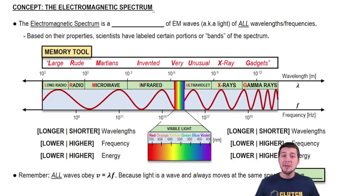
The Electromagnetic Spectrum

Poynting Vector

The Poynting vector (S) quantifies the directional energy flux of an electromagnetic field, defined as S = E × B/μ₀, where E is the electric field, B is the magnetic field, and μ₀ is the permeability of free space. It indicates the power per unit area carried by the wave and points in the direction of energy flow. Understanding the Poynting vector is essential for analyzing the energy transfer in electromagnetic waves.
Recommended video:
Guided course
06:44
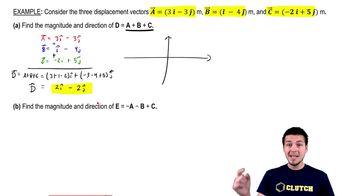
Adding 3 Vectors in Unit Vector Notation

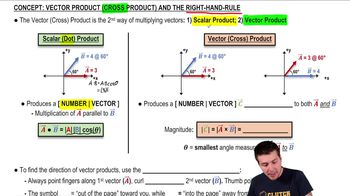
Vector Cross Product

The vector cross product is a mathematical operation that takes two vectors and produces a third vector that is perpendicular to the plane formed by the original vectors. In the context of the Poynting vector, the cross product of the electric field vector and the magnetic field vector determines the direction and magnitude of energy flow in an electromagnetic wave. This operation is crucial for calculating the Poynting vector accurately.
Recommended video:
Guided course
10:30
Vector (Cross) Product and the Right-Hand-Rule
Related Practice
Textbook Question

When the Voyager 2 spacecraft passed Neptune in 1989, it was 4.5×10⁹ km from the earth. Its radio transmitter, with which it sent back data and s, broadcast with a mere 21 W of power. Assuming that the transmitter broadcast equally in all directions, What signal intensity was received on the earth?

2
views
Textbook Question

The intensity of sunlight reaching the earth is 1360 W/m2. Assuming all the sunlight is absorbed, what is the radiation-pressure force on the earth? Give your answer in newtons.

1
views
Textbook Question

A 1.0 μF capacitor is discharged, starting at t = 0 s.The displacement current between the plates is Idisp=(10 A)exp(t2.0 μs)I_{\(\text{disp}\)}=(10\(\text{ A}\))\(\exp\]\left\)(-\(\frac{t}{2.0\text{ }\)}\(\mu\[\text{s}\]\right\)). What was the capacitor’s initial voltage (ΔVC)₀?

1
views
Textbook Question

What is the total energy density in an electromagnetic wave of intensity 1000 W/m2?

Textbook Question

At one instant, the electric and magnetic fields at one point of an electromagnetic wave are E=(200i^+300j^50k^) V/m\(\overrightarrow{E}\)=(200\(\hat{i}\)+300\(\hat{j}\)-50\(\hat{k}\))\(\text{ V/m}\) and B=B0(7.3i^7.3j^+ak^) μT\(\overrightarrow{B}\)=B_0(7.3\(\hat{i}\)-7.3\(\hat{j}\)+a\(\hat{k}\))\(\text{ }\[\mu\]\text{T}\). What are the values of aa and B0B_0?

1
views
Textbook Question

FIGURE P31.38 shows the electric field inside a cylinder of radius R=3.0R=3.0 mm. The field strength is increasing with time as E=1.0×10⁸t2E=1.0\(\times\)10^8t^{2} V/m, where t is in s. The electric field outside the cylinder is always zero, and the field inside the cylinder was zero for t<0t<0. Find an expression for the electric flux ΦeΦ_e through the entire cylinder as a function of time.

1
views