Ch 34: Ray Optics
Knight Calc - Physics for Scientists and Engineers 5th Edition
Knight Calc5th EditionPhysics for Scientists and EngineersISBN: 9780137344796Not the one you use?Change textbook
Chapter 34, Problem 4

A 5.0-cm-thick layer of oil is sandwiched between a 1.0-cm-thick sheet of glass and a 2.0-cm-thick sheet of polystyrene plastic. How long (in ns) does it take light incident perpendicular to the glass to pass through this 8.0-cm-thick sandwich?

Verified step by step guidance
1
Step 1: Identify the refractive indices of the materials involved. For this problem, the refractive index of glass (n_glass) is approximately 1.5, the refractive index of oil (n_oil) is approximately 1.2, and the refractive index of polystyrene plastic (n_polystyrene) is approximately 1.6.
Step 2: Recall the relationship between the speed of light in a medium and its refractive index. The speed of light in a medium (v) is given by the formula: v = cn, where c is the speed of light in a vacuum (approximately 3.0 × 10⁸ m/s) and n is the refractive index of the medium.
Step 3: Calculate the time it takes for light to travel through each layer. The time (t) is given by: t = dv, where d is the thickness of the layer and v is the speed of light in that layer. For each layer, substitute the respective thickness (converted to meters) and refractive index into the formulas for v and t.
Step 4: Add the times for all three layers to find the total time. The total time is the sum of the times for the glass, oil, and polystyrene layers: ttotal = tglass + toil + tpolystyrene. Ensure all times are in seconds before converting the final result to nanoseconds (1 ns = 10⁻⁹ s).
Step 5: Perform the unit conversion to express the total time in nanoseconds. Multiply the total time in seconds by 10⁹ to obtain the final result in nanoseconds.

Verified video answer for a similar problem:

This video solution was recommended by our tutors as helpful for the problem above.
Was this helpful?

Key Concepts

Here are the essential concepts you must grasp in order to answer the question correctly.

Speed of Light in Different Media

The speed of light varies depending on the medium it travels through. In a vacuum, light travels at approximately 3.00 x 10^8 m/s, but this speed decreases in materials like glass, oil, and polystyrene due to their refractive indices. Understanding how to calculate the speed of light in each medium is essential for determining the total time taken for light to pass through the layered structure.
Recommended video:
Guided course
03:41
Speed of pulleys of different radii

Refractive Index

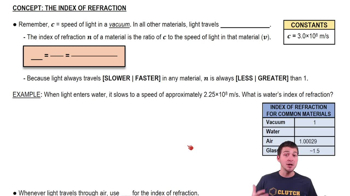
The refractive index is a dimensionless number that describes how much light slows down in a medium compared to its speed in a vacuum. Each material has a specific refractive index, which affects the speed of light as it transitions between different media. This concept is crucial for calculating the effective speed of light in the layered arrangement of glass, oil, and polystyrene.
Recommended video:
Guided course
03:46
Index of Refraction

Time Calculation for Light Travel

To find the time it takes for light to travel through a medium, the formula time = distance/speed is used. By calculating the distance light travels in each layer and using the respective speeds derived from the refractive indices, one can determine the total time for light to traverse the entire 8.0-cm-thick sandwich of materials. This calculation is key to answering the question.
Recommended video:
Guided course
04:43
Calculating Displacement from Velocity-Time Graphs