Ch 08: Dynamics II: Motion in a Plane
Knight Calc - Physics for Scientists and Engineers 5th Edition
Knight Calc5th EditionPhysics for Scientists and EngineersISBN: 9780137344796Not the one you use?Change textbook
Chapter 8, Problem 32a

CALC A 100 g bead slides along a frictionless wire with the parabolic shape y = (2m-1) x2. Find an expression for ay, the vertical component of acceleration, in terms of x, vx, and ax. Hint: Use the basic definitions of velocity and acceleration.

Verified step by step guidance
1
Step 1: Start by recalling the relationship between position, velocity, and acceleration. Velocity is the derivative of position with respect to time, and acceleration is the derivative of velocity with respect to time. For this problem, the bead's position is given by the parabolic equation y = (2m⁻¹)x².
Step 2: Differentiate the given equation y = (2m⁻¹)x² with respect to time (t) to find the vertical velocity vᵧ. Using the chain rule, we get vᵧ = dy/dt = d/dx[(2m⁻¹)x²] * dx/dt = 4m⁻¹ * x * vₓ, where vₓ = dx/dt is the horizontal velocity.
Step 3: Differentiate vᵧ = 4m⁻¹ * x * vₓ with respect to time (t) to find the vertical acceleration aᵧ. Again, use the chain rule: aᵧ = dvᵧ/dt = d/dx[4m⁻¹ * x * vₓ] * dx/dt + d/dvₓ[4m⁻¹ * x * vₓ] * dvₓ/dt.
Step 4: Simplify the expression for aᵧ. The first term becomes (4m⁻¹ * vₓ) * vₓ = 4m⁻¹ * x * aₓ, where aₓ = dvₓ/dt is the horizontal acceleration. The second term involves the derivative of vₓ with respect to time, which contributes to the overall expression for aᵧ.
Step 5: Combine the terms to express aᵧ in terms of x, vₓ, and aₓ. The final expression for aᵧ is aᵧ = 4m⁻¹ * x * aₓ + 4m⁻¹ * vₓ². This represents the vertical component of acceleration in terms of the given variables.

Verified video answer for a similar problem:

This video solution was recommended by our tutors as helpful for the problem above.
Video duration:
4m
Was this helpful?

Key Concepts

Here are the essential concepts you must grasp in order to answer the question correctly.

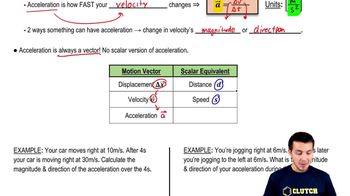
Acceleration

Acceleration is the rate of change of velocity with respect to time. In this context, it can be broken down into components, such as the vertical component (aᵧ) and the horizontal component (aₓ). Understanding how to express acceleration in terms of position and velocity is crucial for analyzing motion along a curved path.
Recommended video:
Guided course
05:47
Intro to Acceleration

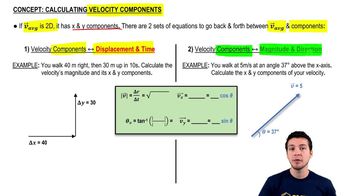
Velocity Components

Velocity can be decomposed into its components along different axes, typically horizontal (vₓ) and vertical (vᵧ). For a particle moving along a curve, the relationship between these components is essential for determining the overall motion. The horizontal and vertical components can be related through the geometry of the path, which in this case is a parabolic shape.
Recommended video:
Guided course
05:53
Calculating Velocity Components

Curvilinear Motion

Curvilinear motion refers to the motion of an object along a curved path. In this scenario, the bead moves along a parabolic wire, which means its acceleration and velocity must be analyzed in relation to the curvature of the path. The shape of the trajectory affects how the components of acceleration and velocity are calculated, particularly when using calculus to relate position, velocity, and acceleration.
Recommended video:
Related Practice
Textbook Question

A toy train rolls around a horizontal 1.0-m-diameter track. The coefficient of rolling friction is 0.10. How long does it take the train to stop if it's released with an angular speed of 30 rpm?

1
views

Textbook Question

You are driving your 1800 kg car at 25 m/s over a circular hill that has a radius of 150 m. A deer running across the road causes you to hit the brakes hard while right at the summit of the hill, and you start to skid. The coefficient of kinetic friction between your tires and the road is 0.75. What is the magnitude of your acceleration as you begin to slow?

2
views
Textbook Question

A 250 g ball is launched with a speed of 35 m/s at a 30° angle. A strong headwind exerts a constant horizontal drag force on the ball. What is the magnitude of the drag force if the wind reduces the ball's travel distance by 20%?

1
views
Textbook Question

A car can just barely turn a corner on an unbanked road at 45 km/h on a dry sunny day. What is the car's maximum cornering speed on a rainy day when the coefficient of static friction has been reduced by 50%?

2
views
Textbook Question

A motorcycle daredevil plans to ride up a 2.0-m-high, 20° ramp, sail across a 10-m-wide pool filled with hungry crocodiles, and land at ground level on the other side. He has done this stunt many times and approaches it with confidence. Unfortunately, the motorcycle engine dies just as he starts up the ramp. He is going 11 m/s at that instant, and the rolling friction of his rubber tires (coefficient 0.02) is not negligible. Does he survive, or does he become crocodile food? Justify your answer by calculating the distance he travels through the air after leaving the end of the ramp.

1
views
Textbook Question

An 85,000 kg stunt plane performs a loop-the-loop, flying in a 260-m-diameter vertical circle. At the point where the plane is flying straight down, its speed is 55 m/s and it is speeding up at a rate of 12 m/s per second. What angle does the net force make with the horizontal? Let an angle above horizontal be positive and an angle below horizontal be negative.

2
views