
Ch 11: Impulse and Momentum
Knight Calc - Physics for Scientists and Engineers 5th Edition
Knight Calc5th EditionPhysics for Scientists and EngineersISBN: 9780137344796Not the one you use?Change textbook
Chapter 11, Problem 40

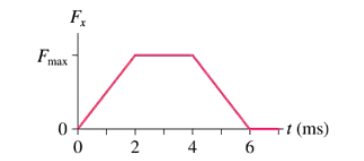
A 60 g tennis ball with an initial speed of 32 m/s hits a wall and rebounds with the same speed. FIGURE P11.40 shows the force of the wall on the ball during the collision. What is the value of Fmax , the maximum value of the contact force during the collision?

Verified step by step guidance
1
Step 1: Analyze the graph provided. The graph shows the force exerted by the wall on the tennis ball as a function of time during the collision. The force increases linearly from 0 to Fmax over the first 2 ms, remains constant at Fmax for the next 2 ms, and then decreases linearly back to 0 over the final 2 ms.
Step 2: Recall the impulse-momentum theorem, which states that the impulse (the area under the force-time graph) is equal to the change in momentum of the object. The formula for impulse is: I=Fdt, and the change in momentum is given by: Δp=mv.
Step 3: Calculate the change in momentum of the tennis ball. Since the ball rebounds with the same speed but in the opposite direction, the total change in momentum is: Δp=m(v--v)=2mv. Here, m is the mass of the ball (60 g or 0.06 kg) and v is the speed (32 m/s).
Step 4: Use the impulse-momentum theorem to relate the impulse to the change in momentum. The impulse is equal to the area under the force-time graph, which consists of a trapezoid. The area of the trapezoid can be calculated as: Area=(Base)(Height). The base is the total time of the collision (6 ms or 0.006 s), and the height is Fmax.
Step 5: Solve for Fmax using the relationship between impulse and change in momentum. Set the impulse (area under the graph) equal to the change in momentum: Fmax=(Δp)/(Base). Substitute the values for Δp and the base to find Fmax.

Verified video answer for a similar problem:

This video solution was recommended by our tutors as helpful for the problem above.
Was this helpful?

Key Concepts

Here are the essential concepts you must grasp in order to answer the question correctly.

Impulse and Momentum

Impulse is the change in momentum of an object when a force is applied over a period of time. It is calculated as the product of the average force and the time duration of the force application. In this scenario, the tennis ball experiences an impulse when it collides with the wall, which changes its momentum from moving towards the wall to moving away from it.
Recommended video:
Guided course
06:00
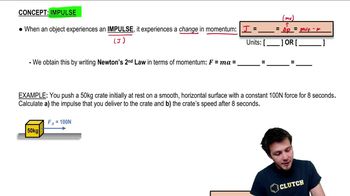
Impulse & Impulse-Momentum Theorem

Newton's Third Law of Motion

Newton's Third Law states that for every action, there is an equal and opposite reaction. When the tennis ball hits the wall, the wall exerts a force on the ball, and simultaneously, the ball exerts an equal force back on the wall. This interaction is crucial for understanding the forces involved during the collision and helps in determining the maximum contact force experienced by the ball.
Recommended video:
Guided course
08:01
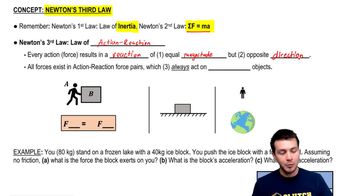
Newton's Third Law & Action-Reaction Pairs

Force-Time Graph

A force-time graph visually represents how force varies with time during an interaction. In this case, the graph shows the maximum force exerted on the tennis ball during the collision with the wall. The area under the force-time curve corresponds to the impulse experienced by the ball, which is essential for calculating the change in momentum and understanding the dynamics of the collision.
Recommended video:
Guided course
05:59
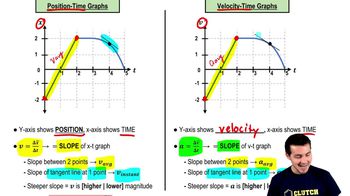
Velocity-Time Graphs & Acceleration
Related Practice
Textbook Question

A tennis player swings her 1000g racket with a speed of 10 m/s. She hits a 60g tennis ball that was approaching her at a speed of 20 m/s. The ball rebounds at 40 m/s. If the tennis ball and racket are in contact for 10 ms, what is the average force that the racket exerts on the ball? How does this compare to the gravitational force on the ball?

1
views
Textbook Question

Most geologists believe that the dinosaurs became extinct 65 million years ago when a large comet or asteroid struck the earth, throwing up so much dust that the sun was blocked out for a period of many months. Suppose an asteroid with a diameter of 2.0 km and a mass of 1.0×10¹³ kg hits the earth (6.0×10²⁴ kg) with an impact speed of 4.0×10⁴ m/s. What percentage is this of the earth's speed around the sun? The earth orbits the sun at a distance of 1.5×10¹¹ m .

1
views
Textbook Question

A 20 g ball of clay traveling east at 3.0 m/s collides with a 30 g ball of clay traveling north at 2.0 m/s. What are the speed and the direction of the resulting 50 g ball of clay? Give your answer as an angle north of east.

1
views
Textbook Question

A particle of mass m is at rest at t = 0. Its momentum for t > 0 is given by px = 6t² kg m/s, where t is in s. Find an expression for Fx(t), the force exerted on the particle as a function of time.

1
views
Textbook Question

A 550 g cart is released from rest on a frictionless, 30° ramp, 120 cm from the bottom of the ramp. It rolls down, bounces off a rubber block at the bottom, and then rolls 80 cm back up the ramp. A high-speed video shows that the cart was in contact with the rubber block for 25 ms. What was the average force exerted on the cart by the block?

2
views
Textbook Question

BIO Squids rely on jet propulsion to move around. A 1.50 kg squid (including the mass of water inside the squid) drifting at 0.40m/s suddenly ejects 0.100 kg of water to get itself moving at 2.50m/s . If drag is ignored over the small interval of time needed to expel the water (the impulse approximation), what is the water’s ejection speed relative to the squid?

1
views