You are given two vectors A = -3i + 6j and B = 7i + 2j. Let Counterclockwise angles be positive. What angle does A make with the +x-axis?

Ch 01: Units, Physical Quantities & Vectors
Young & Freedman Calc14th EditionUniversity PhysicsISBN: 9780321973610Not the one you use?Change textbook
All textbooks
Young & Freedman Calc 14th Edition
Ch 01: Units, Physical Quantities & Vectors
Problem 38a
Young & Freedman Calc 14th Edition
Ch 01: Units, Physical Quantities & Vectors
Problem 38aChapter 1, Problem 38a
Given two vectors A = 4i + 7j and B = 5i - 2j, find the magnitude of each vector.
Verified step by step guidance1
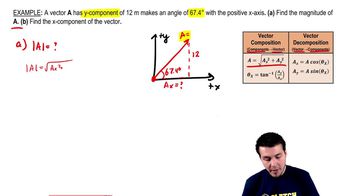
To find the magnitude of a vector, use the formula: \( |\mathbf{A}| = \sqrt{A_x^2 + A_y^2} \), where \( A_x \) and \( A_y \) are the components of vector \( \mathbf{A} \).
For vector \( \mathbf{A} = 4\mathbf{i} + 7\mathbf{j} \), identify the components: \( A_x = 4 \) and \( A_y = 7 \).
Substitute the components of vector \( \mathbf{A} \) into the magnitude formula: \( |\mathbf{A}| = \sqrt{4^2 + 7^2} \).
Similarly, for vector \( \mathbf{B} = 5\mathbf{i} - 2\mathbf{j} \), identify the components: \( B_x = 5 \) and \( B_y = -2 \).
Substitute the components of vector \( \mathbf{B} \) into the magnitude formula: \( |\mathbf{B}| = \sqrt{5^2 + (-2)^2} \).

Verified video answer for a similar problem:
This video solution was recommended by our tutors as helpful for the problem above.
Video duration:
1mWas this helpful?
Key Concepts
Here are the essential concepts you must grasp in order to answer the question correctly.
Vector Magnitude
The magnitude of a vector is a measure of its length and is calculated using the Pythagorean theorem. For a vector A = ai + bj, the magnitude is given by |A| = √(a² + b²). This formula helps determine the size of the vector in the coordinate plane.
Recommended video:
Guided course
Calculating Magnitude & Components of a Vector
Vector Components
Vectors are represented by components along the coordinate axes, typically denoted as i and j for the x and y axes, respectively. Understanding vector components is crucial for calculating vector magnitude and performing operations like addition or subtraction.
Recommended video:
Guided course
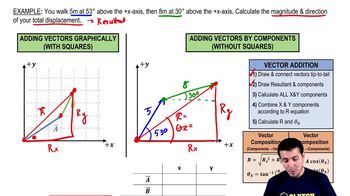
Vector Addition By Components
Pythagorean Theorem
The Pythagorean theorem is a fundamental principle in geometry that relates the lengths of the sides of a right triangle. It states that in a right triangle, the square of the hypotenuse is equal to the sum of the squares of the other two sides, which is essential for calculating vector magnitudes.
Recommended video:
Guided course
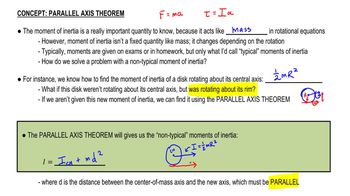
Parallel Axis Theorem
Related Practice
Textbook Question
Textbook Question
In each case, find the x- and y- components of vector A: A = 11.2j - 9.91i
5
views
1
rank
Textbook Question
Vector A is 2.80 cm long and is 60.0° above the x-axis in the first quadrant. Vector B is 1.90 cm long and is 60.0° below the x-axis in the fourth quadrant (Fig. E1.35). Use components to find the magnitude and direction of A - B In each case, sketch the vector addition or subtraction and show that your numerical answers are in qualitative agreement with your sketch.
17
views
Textbook Question
Find the magnitude and direction of the vector represented by the following pairs of components: Ax = −8.60 cm, Ay = 5.20 cm
5
views
Textbook Question
Given two vectors A = -2i + 3j + 4k and B = 3.00î + 1.00ĵ − 3.00k, find the magnitude of each vector.
2
views
Textbook Question
Find the scalar product of the vectors A and B given in Exercise 1.38.
3
views