
An inclined plane, fixed to the inside of an elevator, makes a 38° angle with the floor. A mass m slides on the plane without friction. What is its acceleration relative to the plane if the elevator moves upward at constant speed?
A particle is released at a height rE (radius of Earth) above the Earth’s surface. Determine its velocity when it hits the Earth. Ignore air resistance. [Hint: Use Newton’s second law, the law of universal gravitation, the chain rule, and integrate.]
Verified step by step guidance
Verified video answer for a similar problem:
Key Concepts
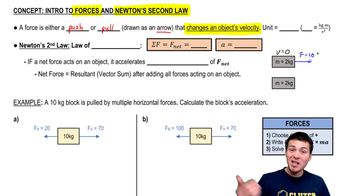
Newton's Second Law
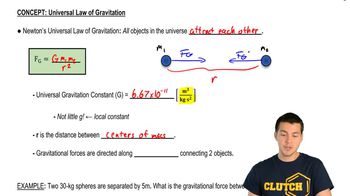
Law of Universal Gravitation
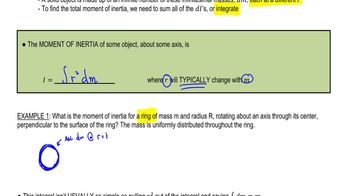
Integration and the Chain Rule
A plumb bob (a mass m hanging on a string) is deflected from the vertical by an angle θ due to a massive mountain nearby (Fig. 6–37). Estimate the angle θ of the plumb bob if it is 5 km from the center of Mt. Everest.
Determine the mean distance from Jupiter for each of Jupiter’s principal moons, using Kepler’s third law. Use the mean distance of Io and the periods given in Table 6–3. Compare your results to the values in Table 6–3.
A satellite circles a spherical planet of unknown mass in a circular orbit of radius 1.6 x 10⁷ m. The magnitude of the gravitational force exerted on the satellite by the planet is 120 N. What would be the magnitude of the gravitational force exerted on the satellite by the planet if the radius of the orbit were increased to 3.0 x 10⁷m?
