
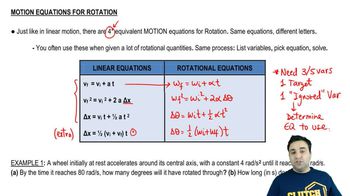
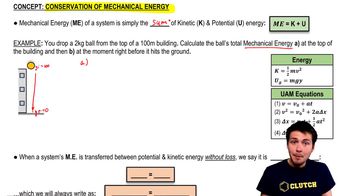
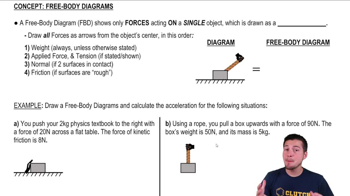
A solid spherical marble shot up a frictionless 15° slope rolls 2.50 m to its highest point. If the marble is shot with the same speed up a slightly rough 15° slope, it rolls only 2.30 m. What is the coefficient of rolling friction on the second slope?
A long, thin rod of mass M and length L is standing straight up on a table. Its lower end rotates on a frictionless pivot. A very slight push causes the rod to fall over. As it hits the table, what are the speed of the tip of the rod?
Verified step by step guidance
Verified video answer for a similar problem:
Key Concepts
Rotational Motion
Conservation of Energy
Kinematics of Rigid Bodies
The sphere of mass M and radius R in FIGURE P12.75 is rigidly attached to a thin rod of radius r that passes through the sphere at distance (1/2)R from the center. A string wrapped around the rod pulls with tension T. Find an expression for the sphere's angular acceleration. The rod's moment of inertia is negligible.
The 5.0 kg, 60-cm-diameter disk in FIGURE P12.71 rotates on an axle passing through one edge. The axle is parallel to the floor. The cylinder is held with the center of mass at the same height as the axle, then released. What is the cylinder's angular velocity when it is directly below the axle?
A long, thin rod of mass M and length L is standing straight up on a table. Its lower end rotates on a frictionless pivot. A very slight push causes the rod to fall over. As it hits the table, what are the angular velocity
A satellite follows the elliptical orbit shown in FIGURE P12.77. The only force on the satellite is the gravitational attraction of the planet. The satellite's speed at point 1 is 8000 m/s. What is the satellite's speed at point 2?
A satellite follows the elliptical orbit shown in FIGURE P12.77. The only force on the satellite is the gravitational attraction of the planet. The satellite's speed at point 1 is 8000 m/s. Does the satellite experience any torque about the center of the planet? Explain.
