
Ch 11: Impulse and Momentum
Knight Calc - Physics for Scientists and Engineers 5th Edition
Knight Calc5th EditionPhysics for Scientists and EngineersISBN: 9780137344796Not the one you use?Change textbook
Chapter 11, Problem 16

A 10-m-long glider with a mass of 680 kg (including the passengers) is gliding horizontally through the air at 30 m/s when a 60 kg skydiver drops out by releasing his grip on the glider. What is the glider's velocity just after the skydiver lets go?

Verified step by step guidance
1
Identify the principle to use: This is a conservation of momentum problem. Since no external horizontal forces act on the system (glider + skydiver), the total momentum before and after the skydiver lets go must remain constant.
Write the equation for conservation of momentum: \( m_1 v_1 + m_2 v_2 = m_1 v_1' + m_2 v_2' \), where \( m_1 \) and \( m_2 \) are the masses of the glider and skydiver, respectively, \( v_1 \) and \( v_2 \) are their initial velocities, and \( v_1' \) and \( v_2' \) are their velocities after the skydiver lets go.
Simplify the equation: Initially, both the glider and the skydiver are moving together at the same velocity \( v = 30 \ \text{m/s} \). Thus, the initial momentum is \( (m_1 + m_2)v \). After the skydiver lets go, the glider's velocity changes to \( v_1' \), and the skydiver continues moving at \( v_2' = 30 \ \text{m/s} \) (since no horizontal forces act on him). The equation becomes \( (m_1 + m_2)v = m_1 v_1' + m_2 v_2' \).
Substitute the known values: \( m_1 = 680 \ \text{kg} \), \( m_2 = 60 \ \text{kg} \), \( v = 30 \ \text{m/s} \), and \( v_2' = 30 \ \text{m/s} \). The equation becomes \( (680 + 60)(30) = 680v_1' + 60(30) \).
Solve for \( v_1' \): Rearrange the equation to isolate \( v_1' \): \( v_1' = \frac{(680 + 60)(30) - 60(30)}{680} \). This gives the glider's velocity just after the skydiver lets go.

Verified video answer for a similar problem:

This video solution was recommended by our tutors as helpful for the problem above.
Video duration:
6m
Was this helpful?

Key Concepts

Here are the essential concepts you must grasp in order to answer the question correctly.

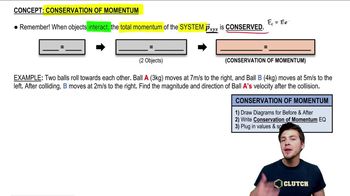
Conservation of Momentum

The principle of conservation of momentum states that in a closed system, the total momentum before an event must equal the total momentum after the event, provided no external forces act on it. In this scenario, the momentum of the glider and skydiver system before the skydiver drops out must equal the momentum of the glider and the skydiver after the drop.
Recommended video:
Guided course
05:58
Conservation Of Momentum

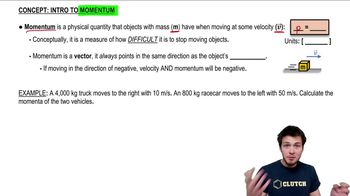
Momentum Calculation

Momentum is calculated as the product of an object's mass and its velocity (p = mv). For the glider and skydiver, we need to calculate their individual momenta before and after the skydiver releases his grip to determine the glider's new velocity. This involves using the initial mass and velocity of the glider and the mass of the skydiver.
Recommended video:
Guided course
05:17
Intro to Momentum

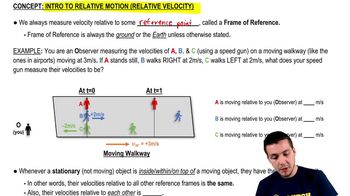
Relative Velocity

Relative velocity refers to the velocity of an object as observed from another object. In this case, the skydiver initially shares the same horizontal velocity as the glider. When the skydiver drops out, he continues to move horizontally at the same speed as the glider at the moment of release, which is crucial for calculating the glider's new velocity after the separation.
Recommended video:
Guided course
04:27
Intro to Relative Motion (Relative Velocity)