Ch 28: Fundamentals of Circuits
Knight Calc - Physics for Scientists and Engineers 5th Edition
Knight Calc5th EditionPhysics for Scientists and EngineersISBN: 9780137344796Not the one you use?Change textbook
Chapter 28, Problem 2

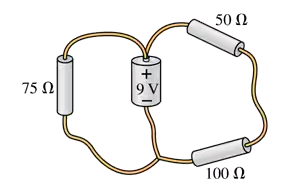
Draw a circuit diagram for the circuit of FIGURE EX28.2.
Circuit diagram showing a 9V battery connected to three resistors: 75Ω, 50Ω, and 100Ω in a combination circuit.

Verified step by step guidance
1
Identify the components of the circuit described in FIGURE EX28.2, such as resistors, capacitors, inductors, voltage sources, or current sources. Note their arrangement and connections.
Determine the type of circuit (e.g., series, parallel, or a combination) based on the description or visual representation provided in FIGURE EX28.2.
Use standard circuit symbols to represent each component. For example, use a zigzag line for resistors, a pair of parallel lines for capacitors, and a coil for inductors.
Arrange the components in the diagram according to their connections in the circuit. Ensure that all nodes and branches are accurately represented, and label each component with its value or identifier if provided.
Double-check the diagram for accuracy, ensuring that it matches the configuration described in FIGURE EX28.2 and adheres to standard circuit diagram conventions.

Verified video answer for a similar problem:

This video solution was recommended by our tutors as helpful for the problem above.
Video duration:
2m
Was this helpful?

Key Concepts

Here are the essential concepts you must grasp in order to answer the question correctly.

Circuit Diagram

A circuit diagram is a graphical representation of an electrical circuit, showing the components and their connections. It uses standardized symbols to represent elements like resistors, capacitors, and power sources, allowing for easy understanding and analysis of the circuit's function. Accurate circuit diagrams are essential for troubleshooting and constructing electrical systems.
Recommended video:
Guided course
08:07
Work and PV Diagrams

Components of a Circuit

Electrical circuits consist of various components, including power sources (like batteries), conductors (wires), and loads (like resistors or bulbs). Each component has a specific role; for example, power sources provide energy, while loads consume it. Understanding these components and their functions is crucial for drawing and analyzing circuit diagrams.
Recommended video:
Guided course
07:30
Vector Addition By Components

Ohm's Law

Ohm's Law is a fundamental principle in electronics that relates voltage (V), current (I), and resistance (R) in a circuit, expressed as V = IR. This law helps in calculating the behavior of electrical circuits, allowing one to determine how much current will flow through a circuit given a certain voltage and resistance. Mastery of Ohm's Law is essential for analyzing and designing circuits.
Recommended video:
Guided course
03:07
Resistance and Ohm's Law