
Textbook Question
The horizontal beam in Fig. E11.14 weighs 190 N, and its center of gravity is at its center. Find the tension in the cable.
1
views

 Verified step by step guidance

 08:55
08:55
 14:47
14:47 14:02
14:02The horizontal beam in Fig. E11.14 weighs 190 N, and its center of gravity is at its center. Find the tension in the cable.
A 9.00-m-long uniform beam is hinged to a vertical wall and held horizontally by a 5.00-m-long cable attached to the wall 4.00 m above the hinge (Fig. E11.17). The metal of this cable has a test strength of 1.00 kN, which means that it will break if the tension in it exceeds that amount. What is the heaviest beam that the cable can support in this configuration?
A 15,000-N crane pivots around a friction-free axle at its base and is supported by a cable making a 25° angle with the crane (Fig. E11.18). The crane is 16 m long and is not uniform, its center of gravity being 7.0 m from the axle as measured along the crane. The cable is attached 3.0 m from the upper end of the crane. When the crane is raised to 55° above the horizontal holding an 11,000-N pallet of bricks by a 2.2-m, very light cord, find the tension in the cable. Start with a free-body diagram of the crane.
The horizontal beam in Fig. E11.14 weighs 190 N, and its center of gravity is at its center. Find the horizontal and vertical components of the force exerted on the beam at the wall.
A 9.00 m-long uniform beam is hinged to a vertical wall and held horizontally by a 5.00 m-long cable attached to the wall 4.00 m above the hinge (Fig. E11.17). The metal of this cable has a test strength of 1.00 kN, which means that it will break if the tension in it exceeds that amount. Find the horizontal and vertical components of the force the hinge exerts on the beam. Is the vertical component upward or downward?
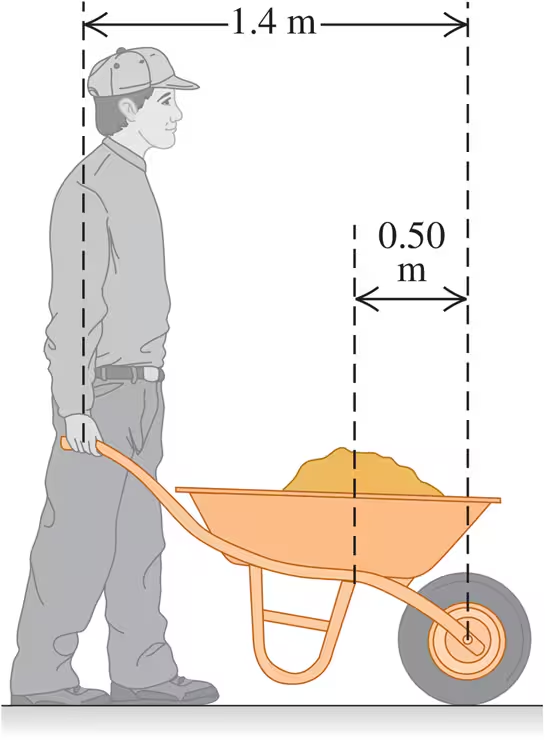
Suppose that you can lift no more than 650 N (around 150 lb) unaided.
How much can you lift using a 1.4 m-long wheelbarrow that weighs 80.0 N and whose center of gravity is 0.50 m from the center of the wheel (Fig. E11.16)? The center of gravity of the load carried in the wheelbarrow is also 0.50 m from the center of the wheel.