
Ch. 31 - Maxwell's Equations and Electromagnetic Waves
Giancoli Douglas - Physics for Scientists and Engineers 5th edition
Giancoli Douglas5th editionPhysics for Scientists and EngineersISBN: 9780137488179Not the one you use?Change textbook
Chapter 30, Problem 10

In an EM wave traveling west, the B field oscillates up and down vertically and has a frequency of 85.0 kHz and an rms strength of 7.75 x 10⁻⁹ T. Determine the frequency and rms strength of the electric field. What is the direction of the electric field oscillations?

Verified step by step guidance
1
The frequency of the electric field in an electromagnetic (EM) wave is the same as the frequency of the magnetic field because both fields oscillate in sync. Therefore, the frequency of the electric field is 85.0 kHz.
The relationship between the electric field (E) and the magnetic field (B) in an EM wave is given by the equation: E=cB, where c is the speed of light in a vacuum (3.00×10⁸ m/s). Use this equation to calculate the rms strength of the electric field: Erms=cBrms.
Substitute the given values into the equation: Erms=3.00×10⁸ m/s×7.75×10-9 T. This will give the rms strength of the electric field.
The direction of the electric field oscillations in an EM wave is perpendicular to both the direction of wave propagation and the direction of the magnetic field oscillations. Since the wave is traveling west and the magnetic field oscillates vertically (up and down), the electric field oscillates horizontally, in the north-south direction.
Summarize: The frequency of the electric field is 85.0 kHz, the rms strength of the electric field can be calculated using the formula Erms=cBrms, and the electric field oscillates in the north-south direction.

Verified video answer for a similar problem:

This video solution was recommended by our tutors as helpful for the problem above.
Video duration:
6m
Was this helpful?

Key Concepts

Here are the essential concepts you must grasp in order to answer the question correctly.

Electromagnetic Waves

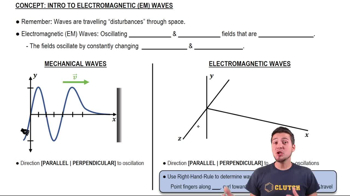
Electromagnetic (EM) waves are oscillations of electric and magnetic fields that propagate through space. In an EM wave, the electric field (E) and magnetic field (B) are perpendicular to each other and to the direction of wave propagation. The frequency of the wave is the rate at which these fields oscillate, and it is the same for both fields.
Recommended video:
Guided course
05:22
Introduction to Electromagnetic (EM) Waves

RMS Strength

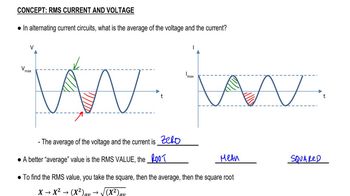
RMS (Root Mean Square) strength is a statistical measure used to determine the effective value of an oscillating quantity, such as electric or magnetic fields. For sinusoidal waves, the RMS value is equal to the peak value divided by the square root of two. This measure is particularly useful in physics for comparing the strength of alternating fields.
Recommended video:
Guided course
07:14
RMS Current and Voltage

Direction of Electric Field Oscillations

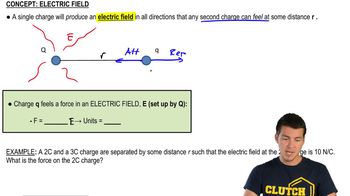
In an EM wave, the electric field oscillates perpendicular to both the magnetic field and the direction of wave propagation. If the wave is traveling west and the magnetic field oscillates vertically, the electric field will oscillate horizontally. The specific direction of the electric field can be determined using the right-hand rule, which helps visualize the orientation of the fields.
Recommended video:
Guided course
03:16
Intro to Electric Fields
Related Practice
Textbook Question

Suppose that a circular parallel-plate capacitor has radius r₀ = 3.0 cm and plate separation d = 5.0 mm. A sinusoidal potential difference V = V₀ sin (2𝝅ft) is applied across the plates, where V₀ = 180 V and f = 60 Hz. Determine the expression for the amplitude B₀(r) of this time-dependent (sinusoidal) field when r ≤ r₀ and when r > r₀.

2
views
Textbook Question

Suppose that a circular parallel-plate capacitor has radius r₀ = 3.0 cm and plate separation d = 5.0 mm. A sinusoidal potential difference V = V₀ sin (2𝝅ft) is applied across the plates, where V₀ = 180 V and f = 60 Hz. In the region between the plates, show that the magnitude of the induced magnetic field is given by B = B₀(r) cos (2𝝅ft), where B₀(r) is a function of the radial distance r from the capacitor’s central axis.

2
views
Textbook Question

Suppose an air-gap capacitor has circular plates of radius r = 2.5 cm and separation d = 1.6 mm. A 68.0-Hz emf, ε = ε₀ cos ωt, is applied to the capacitor. The maximum displacement current is 35 μA. Determine the maximum value of dΦE/dt between the plates. Neglect fringing.

1
views
Textbook Question

(III) (a) When a circular parallel-plate capacitor is being charged as in Example 31–1, show that the Poynting vector S\(\overrightarrow{S}\) points radially inward toward the center of the capacitor, parallel to the plates.

1
views
Textbook Question

(II) Laser light can be focused (at best) to a spot with a radius r equal to its wavelength ⋋. Suppose a 1.0-W beam of green laser light (⋋ = 5 x 10⁻⁷ m) forms such a spot and illuminates a cylindrical object of radius r and length r (Fig. 31–25). Estimate (a) the radiation pressure and force on the object, and (b) its acceleration, if its density equals that of water and it absorbs all the radiation. [This order-of-magnitude calculation convinced researchers of the feasibility of “optical tweezers,” page 916.]

1
views
Textbook Question

(a) When a circular parallel-plate capacitor is being charged as in Example 31–1, show that the Poynting vector S\(\overrightarrow{S}\) points radially inward toward the center of the capacitor, parallel to the plates.

(b) Integrate S\(\overrightarrow{S}\) over the cylindrical boundary of the capacitor gap to show that the rate at which energy enters the capacitor is equal to the rate at which electrostatic energy is being stored in the electric field of the capacitor (Section 24–4). Ignore fringing of E\(\overrightarrow{E}\).