Ch 21: Electric Charge and Electric Field
Young & Freedman Calc - University Physics 14th Edition
Young & Freedman Calc14th EditionUniversity PhysicsISBN: 9780321973610Not the one you use?Change textbook
Chapter 21, Problem 17

Three point charges are arranged along the xx-axis. Charge q1=+3.00q_1=+3.00 μ\(\mu\)C is at the origin, and charge q2=5.00q_2=-5.00 μ\(\mu\)C is at x=0.200x = 0.200 m. Charge q2=8.00q_2=-8.00 μ\(\mu\)C. Where is q3q_3 located if the net force on q1q_1 is 7.007.00 N in the x-x-direction?

Verified step by step guidance
1
Start by understanding that the net force on q1 is the vector sum of the forces exerted by q2 and q3. Since the net force is given as 7.00 N in the -x-direction, this means the force due to q3 must be greater than the force due to q2, and both must be in the -x-direction.
Use Coulomb's Law to express the force between two point charges: F=kqqr2, where k is Coulomb's constant, q are the charges, and r is the distance between them.
Calculate the force exerted by q2 on q1 using the formula: F=k3.005.000.2002. This force will be in the -x-direction because q2 is negative.
Let the distance between q1 and q3 be x. The force exerted by q3 on q1 can be expressed as: F=k3.008.00x2. This force will also be in the -x-direction because q3 is negative.
Set up the equation for the net force: 7.00=k3.008.00x2 - k3.005.000.2002. Solve for x to find the location of q3.

Verified video answer for a similar problem:

This video solution was recommended by our tutors as helpful for the problem above.
Video duration:
10m
Was this helpful?

Key Concepts

Here are the essential concepts you must grasp in order to answer the question correctly.

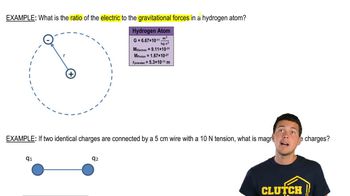
Coulomb's Law

Coulomb's Law describes the electrostatic force between two point charges. The force is directly proportional to the product of the magnitudes of the charges and inversely proportional to the square of the distance between them. The direction of the force is along the line joining the charges, and it is attractive if the charges are opposite and repulsive if they are the same.
Recommended video:
Guided course
09:52
Coulomb's Law

Superposition Principle

The superposition principle states that the net force on a charge due to multiple other charges is the vector sum of the individual forces exerted by each charge. This principle allows us to calculate the total force by considering each pair of charges separately and then adding the forces vectorially, taking into account their magnitudes and directions.
Recommended video:
Guided course
03:32
Superposition of Sinusoidal Wave Functions

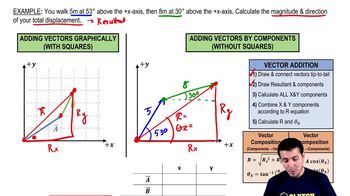
Vector Addition

Vector addition is a method used to combine multiple vectors, such as forces, into a single resultant vector. Each vector is represented by its magnitude and direction, and they are added by aligning them head-to-tail. The resultant vector is drawn from the tail of the first vector to the head of the last vector, providing both the magnitude and direction of the combined effect.
Recommended video:
Guided course
07:30
Vector Addition By Components
Related Practice
Textbook Question

Suppose you had two small boxes, each containing 1.01.0 g of protons.

(a) If one were placed on the moon by an astronaut and the other were left on the earth, and if they were connected by a very light (and very long!) string, what would be the tension in the string? Express your answer in newtons and in pounds. Do you need to take into account the gravitational forces of the earth and moon on the protons? Why?

(b) What gravitational force would each box of protons exert on the other box?

2
views
Textbook Question

A proton is traveling horizontally to the right at 4.50×1064.50\(\times\)10^6 m/s. How much time does it take the proton to stop after entering the field?

Textbook Question

A positive charge qq is fixed at the point x=0x = 0, y=0y = 0, and a negative charge 2q-2q is fixed at the point x=ax = a, y=0 y = 0. Show the positions of the charges in a diagram.

Textbook Question

Three point charges are arranged on a line. Charge q3=+5.00q_3=+5.00 nC and is at the origin. Charge q2=3.00q_2=-3.00 nC and is at x=+4.00x = +4.00 cm. Charge q1q_1 is at x=+2.00x = +2.00 cm. What is q1q_1 (magnitude and sign) if the net force on q3q_3 is zero?

Textbook Question

A proton is traveling horizontally to the right at 4.50×1064.50\(\times\)10^6 m/s. Find the magnitude and direction of the weakest electric field that can bring the proton uniformly to rest over a distance of 3.203.20 cm.

3
views
Textbook Question

The nuclei of large atoms, such as uranium, with 9292 protons, can be modeled as spherically symmetric spheres of charge. The radius of the uranium nucleus is approximately 7.4×10157.4\(\times\)10^{-15} m. What magnitude of electric field does it produce at the distance of the electrons, which is about 1.0×10101.0\(\times\)10^{-10} m?

2
views