Back

The Chain of Infection quiz #1

Control buttons has been changed to "navigation" mode.
1/10
  • What are the essential factors in the chain of infection that must be present for a disease to occur?

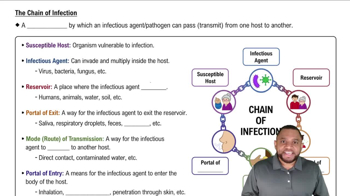
    The essential factors in the chain of infection are: a susceptible host, an infectious agent (pathogen), a reservoir where the agent lives, a portal of exit for the agent to leave the reservoir, a mode of transmission to another host, and a portal of entry into the new host. Disease occurs when all these factors are present and connected.
  • What is the definition of a susceptible host in the chain of infection?

    A susceptible host is an organism that is vulnerable to infection. This vulnerability can be due to factors like a weakened or compromised immune system.
  • How can the portal of exit allow an infectious agent to leave the reservoir?

    The portal of exit is the way an infectious agent escapes from the reservoir. It can occur through saliva, respiratory droplets, feces, or blood.
  • What are some examples of reservoirs besides humans in the chain of infection?

    Reservoirs can include animals, water, or soil in addition to humans. These are places where the infectious agent can live and multiply.
  • Describe two possible modes of transmission for infectious agents.

    Modes of transmission can include direct contact, such as touching, or indirect contact, such as touching contaminated surfaces like doorknobs. Contaminated water is another possible mode.
  • What are some ways an infectious agent can enter a new host through the portal of entry?

    An infectious agent can enter a new host by inhalation, ingestion, or penetration through the skin. These are common portals of entry for pathogens.
  • Why are older adults often considered more susceptible hosts in the chain of infection?

    Older adults may have weakened or compromised immune systems. This makes them more vulnerable to different types of infections.
  • How can handwashing help break the chain of infection?

    Handwashing removes infectious agents from the skin, especially after contact with contaminated surfaces. This interrupts the mode of transmission and prevents the spread of infection.
  • What is the significance of the memory tool 'suspected infection requires extra routes of entry'?

    This memory tool helps recall the steps in the chain of infection: susceptible host, infectious agent, reservoir, portal of exit, mode of transmission, and portal of entry. Each word corresponds to a step in the process.
  • Why is it important to understand all the different paths an infectious agent can take between hosts?

    Understanding these paths allows for targeted interventions to disrupt the chain and prevent disease spread. It helps in controlling infections and protecting vulnerable populations.