Skip to main content
Personal Health
My Course
Learn
Exam Prep
AI Tutor
Study Guides
Flashcards
Try the app
My Course
Learn
Exam Prep
AI Tutor
Study Guides
Flashcards
Try the app
Back
Introduction to Overweight & Obesity definitions
You can tap to flip the card.
Overweight
You can tap to flip the card.
👆
Overweight
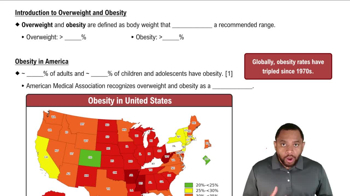
Body weight exceeding recommended range by more than ten percent, indicating increased health risk.
Track progress
Control buttons has been changed to "navigation" mode.
1/15
Related flashcards
Related practice
Recommended videos
Introduction to Overweight & Obesity quiz
Introduction to Overweight & Obesity
20 Terms
Introduction to Overweight & Obesity
Ch.6 Weight Management
4 problems
Topic
Nicole
Body Composition
Ch.6 Weight Management
5 problems
Topic
Brendan
Ch.6 Weight Management - Part 1 of 2
5 topics
9 problems
Chapter
Laura
Ch.6 Weight Management - Part 2 of 2
1 topic
2 problems
Chapter
Laura
Guided course
0:54
Introduction to Overweight and Obesity Example 1
Guided course
5:17
Introduction to Overweight and Obesity Concept 1
2
views
Terms in this set (15)
Hide definitions
Overweight
Body weight exceeding recommended range by more than ten percent, indicating increased health risk.
Obesity
Body weight exceeding recommended range by more than twenty percent, recognized as a disease by medical authorities.
Body Weight
Measurement used to classify health status, with specific thresholds for overweight and obesity.
Prevalence
Proportion of a population affected by a condition, such as overweight or obesity, at a given time.
Genetics
Inherited traits influencing susceptibility to overweight and obesity among individuals and populations.
Environment
External factors, including physical surroundings and social constructs, impacting rates of overweight and obesity.
Lifestyle
Daily habits and behaviors, such as physical activity and diet, contributing to weight status.
Socioeconomic Status
Economic and social position affecting access to resources and opportunities for healthy living.
Disease
Medical condition recognized by organizations like the American Medical Association, including obesity and overweight.
CDC
National public health agency providing data and statistics on overweight and obesity in the United States.
Altitude
Elevation above sea level, studied for its potential influence on obesity rates in certain regions.
Physical Activity
Movement such as hiking, biking, or skiing, associated with lower rates of overweight and obesity.
Health Disparities
Differences in health outcomes, such as obesity rates, among various demographic groups.
Diet
Pattern of food consumption, including regional preferences like fried foods, affecting weight status.
Tripling
Significant increase, as seen in global obesity rates since the 1970s.
 BackBack


 0:54
0:54