Back

Intro to Infection quiz #1

Control buttons has been changed to "navigation" mode.
1/22
  • Which health risk may result from getting a tattoo?

    Getting a tattoo may increase the risk of infection if microorganisms enter the skin during the process.
  • What is a foodborne illness?

    A foodborne illness is a disease caused by consuming food contaminated with infectious microorganisms such as bacteria or viruses.
  • What does the etiology of a disease refer to?

    The etiology of a disease refers to its cause or origin, specifically the factors or microorganisms responsible for the disease.
  • What is a microorganism that causes disease called?

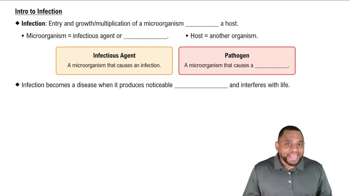
    A microorganism that causes disease is called a pathogen.
  • What is the study of the cause of disease called?

    The study of the cause of disease is called etiology.
  • Which hygiene practice has both social and health benefits?

    Regular handwashing is a hygiene practice that provides both social and health benefits by reducing the spread of infectious microorganisms.
  • What is the difference between a communicable and a noncommunicable disease?

    A communicable disease can be transmitted from one person to another, while a noncommunicable disease cannot be spread between individuals.
  • What does the epidemiologic triad of disease causation refer to?

    The epidemiologic triad refers to the interaction between the host, the agent (such as a microorganism), and the environment in causing disease.
  • How can cytokine storms negatively impact human health?

    Cytokine storms can negatively impact human health by causing an excessive immune response, leading to tissue damage and worsening disease symptoms.
  • What is the most common infectious disease worldwide?

    The most common infectious disease worldwide is the common cold, which is caused by viruses.
  • What is the germ theory of disease?

    The germ theory of disease states that microorganisms are the cause of many diseases.
  • What is an acute disease?

    An acute disease is a disease that develops rapidly and has a short duration, often with noticeable symptoms.
  • What is the study of disease called?

    The study of disease is called pathology.
  • What is a person who studies disease called?

    A person who studies disease is called a pathologist.
  • What is a commonly spread skin disease?

    Impetigo is an example of a commonly spread skin disease caused by bacteria.
  • Which of these is not a communicable disease?

    Diabetes is an example of a noncommunicable disease.
  • Which term means disease producing?

    The term 'pathogenic' means disease producing.
  • What are the stages of infection?

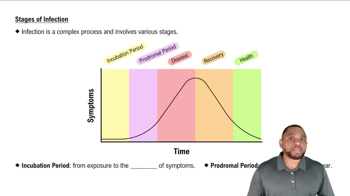
    The stages of infection are incubation, prodromal, disease, recovery, and health.
  • When does an infection become a disease?

    An infection becomes a disease when it produces noticeable symptoms and interferes with daily life.
  • What is the incubation period in the context of infection?

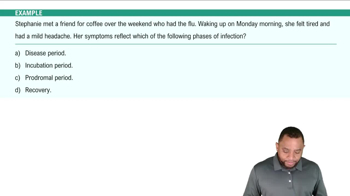
    The incubation period is the time from exposure to a microorganism until the onset of symptoms.
  • What is the prodromal period during infection?

    The prodromal period is when the first symptoms of infection appear.
  • Why is early recognition of symptoms important in managing infectious diseases?

    Early recognition of symptoms is important because it supports effective treatment, improves health outcomes, and reduces the impact of infectious diseases.