Skip to main content
Personal Health
My Course
Learn
Exam Prep
AI Tutor
Study Guides
Flashcards
Try the app
My Course
Learn
Exam Prep
AI Tutor
Study Guides
Flashcards
Try the app
Back
Intro to Diabetes definitions
You can tap to flip the card.
Diabetes Mellitus
You can tap to flip the card.
👆
Diabetes Mellitus
Group of diseases marked by insufficient or ineffective hormone regulation, resulting in elevated blood sugar beyond normal limits.
Track progress
Control buttons has been changed to "navigation" mode.
1/13
Related flashcards
Related practice
Recommended videos
Intro to Diabetes quiz
Intro to Diabetes
20 Terms
Intro to Diabetes quiz #1
Intro to Diabetes
10 Terms
Intro to Diabetes
Ch.10 Major Diseases
4 problems
Topic
Laura
Types of Diabetes
Ch.10 Major Diseases
5 problems
Topic
Brendan
Ch.10 Major Diseases - Part 1 of 2
4 topics
9 problems
Chapter
Brendan
Ch.10 Major Diseases - Part 2 of 2
3 topics
8 problems
Chapter
Nicole
Guided course
2:35
Intro to Diabetes Concept 1
1
views
Guided course
2:05
Diagnosing Diabetes Concept 3
1
views
Guided course
2:50
Intro to Diabetes Example 1
1
views
Terms in this set (13)
Hide definitions
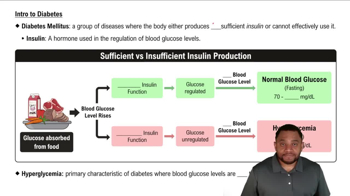
Diabetes Mellitus
Group of diseases marked by insufficient or ineffective hormone regulation, resulting in elevated blood sugar beyond normal limits.
Insulin
Hormone essential for maintaining healthy blood sugar by enabling cells to absorb and regulate glucose from the bloodstream.
Blood Glucose
Sugar circulating in the bloodstream, whose concentration reflects metabolic health and is central to diabetes diagnosis.
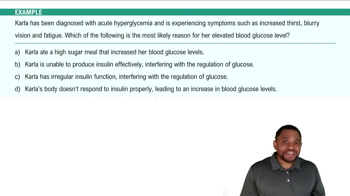
Hyperglycemia
Condition where blood sugar exceeds normal fasting levels, often indicating underlying metabolic dysfunction.
Prediabetes
State with blood sugar above normal but below diabetic threshold, serving as a warning for potential disease progression.
Fasting Phase
Period after eating when the body relies on stored energy, used to assess baseline blood sugar for diagnostic purposes.
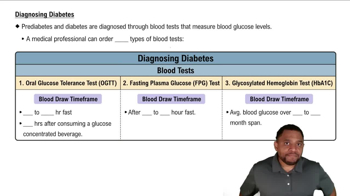
Oral Glucose Tolerance Test
Diagnostic procedure involving a sweet beverage and timed blood draws to evaluate the body's ability to manage sugar.
Fasting Plasma Glucose
Blood test performed after a period without food, measuring baseline sugar to identify metabolic disorders.
Glycosylated Hemoglobin
Long-term indicator of average blood sugar, reflecting metabolic control over several months.
HbA1c
Laboratory value representing the percentage of sugar-bound hemoglobin, used to monitor chronic metabolic health.
Normal Range
Blood sugar values between 70 and 100 mg/dL, indicating healthy metabolic function and effective hormone regulation.
Diagnosis
Process involving specific blood tests to determine the presence or risk of metabolic diseases based on sugar levels.
Protocol
Medical plan designed to manage or prevent progression of metabolic disorders by controlling blood sugar.
 BackBack


 2:35
2:35