
Ch.6 - Alkyl Halides; Nucleophilic Substitution
Wade - Organic Chemistry 9th Edition
Wade9th EditionOrganic ChemistryISBN: 9780135213728Not the one you use?Change textbook
Chapter 6, Problem 6

The reaction of an amine with an alkyl halide gives an ammonium salt.R3N amine + R'—X alkyl halide —> R3(N+)—R' X- ammonium salt The rate of this SN2 reaction is sensitive to the polarity of the solvent. 1. Draw an energy diagram for this reaction in a nonpolar solvent and another in a polar solvent. 2. Consider the nature of the transition state, and explain why this reaction should be sensitive to the polarity of the solvent. 3. Predict whether it will be faster or slower in a more polar solvent.

Verified step by step guidance
1
Identify the key components of the reaction: the amine (R3N), the alkyl halide (R'—X), and the resulting ammonium salt (R3(N+)—R' X-).
Understand that the reaction proceeds via an SN2 mechanism, which involves a single transition state where the nucleophile attacks the electrophile, leading to the inversion of configuration.
Draw the energy diagram for the reaction in a nonpolar solvent: Start with the reactants at a certain energy level, show a single peak representing the transition state, and end with the products at a lower energy level.
Draw the energy diagram for the reaction in a polar solvent: The transition state will be stabilized by the polar solvent, resulting in a lower energy peak compared to the nonpolar solvent diagram.
Explain that the reaction is faster in a polar solvent because the polar solvent stabilizes the transition state, lowering the activation energy and increasing the reaction rate.

Verified video answer for a similar problem:

This video solution was recommended by our tutors as helpful for the problem above.
Video duration:
8m
Was this helpful?

Key Concepts

Here are the essential concepts you must grasp in order to answer the question correctly.

SN2 Reaction Mechanism

The SN2 (substitution nucleophilic bimolecular) reaction mechanism involves a single concerted step where the nucleophile attacks the electrophile, leading to the simultaneous displacement of the leaving group. This mechanism is characterized by a transition state where both the nucleophile and the leaving group are partially bonded to the carbon atom. The reaction rate depends on the concentration of both the nucleophile and the substrate, making it sensitive to steric hindrance and solvent effects.
Recommended video:
Guided course
08:33
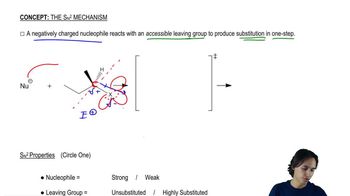
Drawing the SN2 Mechanism

Transition State Theory

Transition state theory describes the high-energy state that occurs during a chemical reaction, where reactants are transformed into products. The transition state is a critical point along the reaction coordinate, representing the highest energy barrier that must be overcome for the reaction to proceed. The nature of the transition state can be influenced by solvent polarity, as polar solvents can stabilize charged transition states, thereby affecting the reaction rate.
Recommended video:
Guided course
06:55
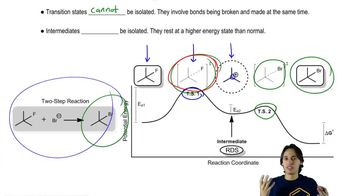
Intermediates vs. Transition States

Solvent Polarity and Reaction Rate

The polarity of a solvent affects the stability of ions and transition states in a reaction. In polar solvents, ionic species are better stabilized due to solvation effects, which can lower the activation energy for reactions involving charged transition states. For the SN2 reaction described, a more polar solvent would stabilize the transition state, potentially leading to a faster reaction rate compared to a nonpolar solvent, where the transition state may be less stabilized.
Recommended video:
5:07
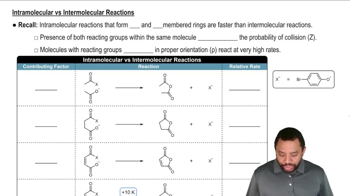
Rates of Intramolecular Reactions Concept 2
Related Practice
Textbook Question

a. Propose a mechanism for the following reaction:

b. Use the bond-dissociation enthalpies given in Table 4-2 (page 167) to calculate the value of ΔH° for each step shown in your mechanism. (The BDE for CH2=CHCH2―Br is about 280 kJ/mol, or 67 kcal/mol.) Calculate the overall value of ΔH° for the reaction. Are these values consistent with a rapid free-radical chain reaction?

1
views
Textbook Question

For each pair of compounds, predict which one has the higher molecular dipole moment, and explain your reasoning.

c. cis-2,3-dibromobut-2-ene or trans-2,3-dibromobut-2-ene

d. cis-1,2-dichlorocyclobutane or trans-1,3-dichlorocyclobutane

3
views
Textbook Question

Show how you might use SN2 reactions to convert 1-chlorobutane into the following compounds.

a. butan-1-ol

4
views
Textbook Question
The reaction of an amine with an alkyl halide gives an ammonium salt.R3N amine + R'—X alkyl halide —> R3(N+)—R' X- ammonium salt The rate of this SN2 reaction is sensitive to the polarity of the solvent. 1. Draw an energy diagram for this reaction in a nonpolar solvent and another in a polar solvent. 2. Consider the nature of the transition state, and explain why this reaction should be sensitive to the polarity of the solvent. 3. Predict whether it will be faster or slower in a more polar solvent.

1
views
Textbook Question

For each pair of compounds, predict which one has the higher molecular dipole moment, and explain your reasoning.

a. ethyl chloride or ethyl iodide

b. 1-bromopropane or cyclopropane

1
views
Textbook Question

For each pair of compounds, predict which compound has the higher boiling point. Check [TABLE 6-2] to see if your prediction was right; then explain why that compound has the higher boiling point.

a. isopropyl bromide and n-butyl bromide

1
views