Ch.6 - Alkyl Halides; Nucleophilic Substitution
Wade - Organic Chemistry 9th Edition
Wade9th EditionOrganic ChemistryISBN: 9780135213728Not the one you use?Change textbook
Chapter 6, Problem 30c

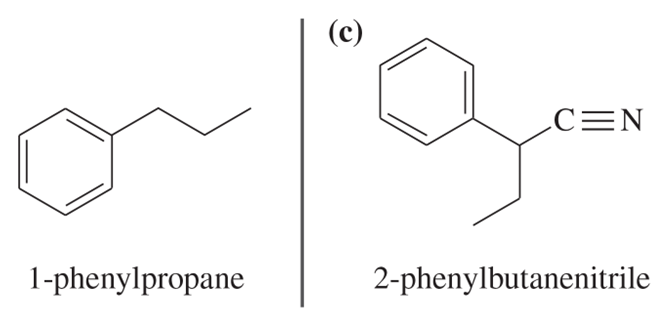
Show how you would convert (in one or two steps) 1-phenylpropane to the three products shown below. In each case, explain what unwanted reactions might produce undesirable impurities in the product.

Verified step by step guidance
1
Step 1: Analyze the starting material, 1-phenylpropane, and the target product, 2-phenylbutanenitrile. The transformation involves the addition of a nitrile group (-C≡N) to the carbon adjacent to the phenyl group, which requires a nucleophilic substitution reaction.
Step 2: Perform bromination of 1-phenylpropane using bromine (Br₂) in the presence of light or heat (radical halogenation conditions). This will selectively brominate the benzylic position (the carbon adjacent to the phenyl group) due to the stability of the benzylic radical intermediate. The product will be 1-bromo-2-phenylpropane.
Step 3: React 1-bromo-2-phenylpropane with sodium cyanide (NaCN) in a polar aprotic solvent like DMSO or acetone. This will result in an SN2 reaction, where the bromine atom is replaced by the cyanide group (-C≡N), forming 2-phenylbutanenitrile.
Step 4: Consider potential side reactions. During bromination, over-bromination (e.g., dibromination) or bromination at non-benzylic positions could occur, leading to impurities. During the SN2 reaction, elimination reactions (E2) might compete, forming alkenes as side products.
Step 5: To minimize impurities, ensure controlled reaction conditions: use excess bromine for selective benzylic bromination and avoid strong bases during the SN2 reaction to suppress elimination pathways.

Verified video answer for a similar problem:

This video solution was recommended by our tutors as helpful for the problem above.
Video duration:
4m
Was this helpful?

Key Concepts

Here are the essential concepts you must grasp in order to answer the question correctly.

Nitrile Formation

Nitriles are organic compounds containing a cyano group (-C≡N). To convert 1-phenylpropane to 2-phenylbutanenitrile, a common method is to perform a nucleophilic substitution or addition reaction, where a suitable reagent, such as a cyanide ion, is introduced to form the nitrile. Understanding the mechanism of this transformation is crucial for predicting the reaction pathway and the conditions required.
Recommended video:
0:59
Review of Nitriles Concept 1

Unwanted Side Reactions

In organic reactions, unwanted side reactions can lead to impurities in the final product. For instance, during the conversion of 1-phenylpropane to 2-phenylbutanenitrile, side reactions such as elimination or rearrangement may occur, resulting in by-products. Identifying these potential side reactions helps in optimizing reaction conditions to minimize impurities.
Recommended video:
2:36
Side-Chain Reactions of Substituted Pyridines Concept 1

Reagent Selection

The choice of reagents is critical in organic synthesis, as it influences both the efficiency and selectivity of the reaction. In the case of converting 1-phenylpropane to 2-phenylbutanenitrile, selecting a suitable cyanide source and reaction conditions (like temperature and solvent) is essential to ensure a high yield of the desired product while reducing the formation of undesired by-products.
Recommended video: