Ch.6 - Alkyl Halides; Nucleophilic Substitution
Wade - Organic Chemistry 9th Edition
Wade9th EditionOrganic ChemistryISBN: 9780135213728Not the one you use?Change textbook
Chapter 6, Problem 50

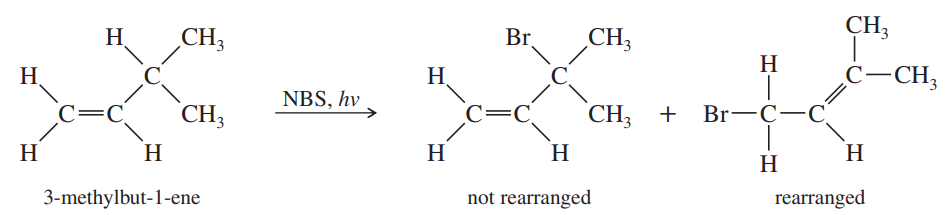
Give a mechanism to explain the two products formed in the following reaction.
Mechanism illustrating allylic bromination of 3-methylbut-1-ene, showing two products: one rearranged and one not rearranged.

Verified step by step guidance
1
Step 1: Recognize the reaction conditions. The reaction involves 3-methylbut-1-ene treated with NBS (N-bromosuccinimide) under light (hv). This indicates a radical bromination reaction, specifically at the allylic position due to the stability of allylic radicals.
Step 2: Initiation step. The light (hv) causes homolytic cleavage of the N-Br bond in NBS, generating a bromine radical (Br•). This radical is highly reactive and initiates the reaction.
Step 3: Formation of the allylic radical. The bromine radical abstracts a hydrogen atom from the allylic position of 3-methylbut-1-ene, forming an allylic radical. The allylic radical is stabilized by resonance, creating two possible resonance structures.
Step 4: Reaction of the allylic radical with bromine. Each resonance structure of the allylic radical reacts with another bromine molecule (Br2, generated from NBS) to form two different products. One product corresponds to the non-rearranged structure, while the other corresponds to the rearranged structure due to the resonance stabilization.
Step 5: Explain the rearranged product. The rearranged product arises because the allylic radical can shift its position via resonance, allowing bromine to attach at a different carbon atom. This leads to the formation of the rearranged brominated product.

Verified video answer for a similar problem:

This video solution was recommended by our tutors as helpful for the problem above.
Video duration:
5m
Was this helpful?

Key Concepts

Here are the essential concepts you must grasp in order to answer the question correctly.

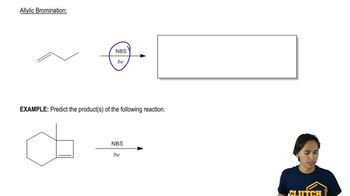
Allylic Bromination

Allylic bromination is a reaction where bromine is added to the allylic position of an alkene, typically using a brominating agent like N-bromosuccinimide (NBS) under light (hv) conditions. This process involves the formation of a radical intermediate, allowing for the substitution of hydrogen atoms at the allylic position with bromine, leading to the formation of different products based on the stability of the intermediates formed.
Recommended video:
Guided course
00:54
Mechanism of Allylic Bromination.

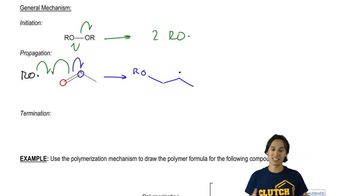
Radical Mechanism

The radical mechanism involves the generation of free radicals, which are highly reactive species with unpaired electrons. In the context of allylic bromination, the reaction proceeds through three main steps: initiation (formation of radicals), propagation (reaction of radicals with the substrate), and termination (combination of radicals). Understanding this mechanism is crucial for predicting the products formed, including both rearranged and non-rearranged structures.
Recommended video:
Guided course
03:28
The mechanism of Radical Polymerization.

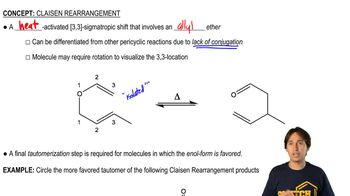
Rearrangement in Organic Reactions

Rearrangement in organic chemistry refers to the structural reorganization of atoms within a molecule during a reaction. In the case of allylic bromination, the formation of a more stable radical can lead to the rearrangement of the product. This concept is essential for understanding why two different products are formed: one that retains the original structure and another that has undergone rearrangement to achieve greater stability.
Recommended video:
Guided course
06:08
Definition of Claisen Rearrangement
Related Practice
Textbook Question

Optically active 2-bromobutane undergoes racemization on treatment with a solution of KBr. Propose a mechanism for this racemization.

1
views

Textbook Question

Triethyloxonium tetrafluoroborate, (CH3CH2)3O+ BF4, is a solid with melting point 91–92°C. Show how this reagent can transfer an ethyl group to a nucleophile (Nuc:) in an SN2 reaction. What is the leaving group? Why might this reagent be preferred to using an ethyl halide? (Consult Table 6-2)

1
views
Textbook Question

Using 1,2-dimethylcyclohexene as your starting material, show how you would synthesize the following compounds. (Once you have shown how to synthesize a compound, you may use it as the starting material in any later parts of this problem.) If a chiral product is shown, assume that it is part of a racemic mixture.

(f)

2
views
Textbook Question

In contrast, optically active butan-2-ol does not racemize on treatment with a solution of KOH. Explain why a reaction like that in part (a) does not occur.

8
views
Textbook Question

Optically active butan-2-ol racemizes in dilute acid. Propose a mechanism for this racemization.

2
views
Textbook Question

Because the SN1 reaction goes through a flat carbocation, we might expect an optically active starting material to give a completely racemized product. In most cases, however, SN1 reactions actually give more of the inversion product. In general, as the stability of the carbocation increases, the excess inversion product decreases. Extremely stable carbocations give completely racemic products. Explain these observations.

1
views