
Ch.6 - Alkyl Halides; Nucleophilic Substitution
Wade - Organic Chemistry 9th Edition
Wade9th EditionOrganic ChemistryISBN: 9780135213728Not the one you use?Change textbook
Chapter 6, Problem 27a,b

For each reaction, give the expected substitution product, and predict whether the ­mechanism will be predominantly first order (SN1) or second order (SN2).
a. 2-chloro-2-methylbutane + CH3COOH
b. isobutylbromide + sodium methoxide

Verified step by step guidance
1
Step 1: Analyze the substrate in each reaction to determine its structure and degree of substitution (primary, secondary, or tertiary). For reaction (a), 2-chloro-2-methylbutane is a tertiary alkyl halide, while for reaction (b), isobutylbromide is a primary alkyl halide.
Step 2: Consider the nucleophile and solvent in each reaction. For reaction (a), CH3COOH is a weak nucleophile and a polar protic solvent, which favors the SN1 mechanism. For reaction (b), sodium methoxide (CH3ONa) is a strong nucleophile and a polar aprotic solvent, which favors the SN2 mechanism.
Step 3: Predict the mechanism for each reaction based on the substrate and nucleophile/solvent combination. Reaction (a) will predominantly proceed via the SN1 mechanism due to the tertiary substrate and polar protic solvent. Reaction (b) will predominantly proceed via the SN2 mechanism due to the primary substrate and strong nucleophile in a polar aprotic solvent.
Step 4: For the substitution product, identify the nucleophile's attack site. In reaction (a), CH3COOH will replace the chlorine atom on the tertiary carbon, forming an ester. In reaction (b), sodium methoxide will replace the bromine atom on the primary carbon, forming an ether.
Step 5: Summarize the expected substitution products and mechanisms. Reaction (a) yields an ester via the SN1 mechanism, while reaction (b) yields an ether via the SN2 mechanism.

Verified video answer for a similar problem:

This video solution was recommended by our tutors as helpful for the problem above.
Video duration:
2m
Was this helpful?

Key Concepts

Here are the essential concepts you must grasp in order to answer the question correctly.

Nucleophilic Substitution Mechanisms

Nucleophilic substitution reactions can occur via two primary mechanisms: SN1 and SN2. SN1 reactions involve a two-step process where the leaving group departs first, forming a carbocation intermediate, followed by nucleophilic attack. In contrast, SN2 reactions are single-step processes where the nucleophile attacks the substrate simultaneously as the leaving group departs, leading to a concerted mechanism.
Recommended video:
Guided course
01:47
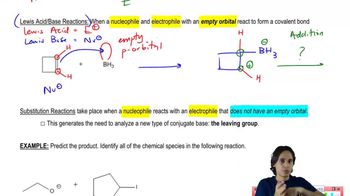
Nucleophiles and Electrophiles can react in Substitution Reactions.

Factors Influencing SN1 vs. SN2

The choice between SN1 and SN2 mechanisms is influenced by several factors, including the structure of the substrate, the strength of the nucleophile, and the solvent used. Tertiary substrates favor SN1 due to stable carbocation formation, while primary substrates favor SN2 due to steric accessibility. Polar protic solvents stabilize carbocations, promoting SN1, whereas polar aprotic solvents enhance nucleophilicity, favoring SN2.
Recommended video:
Guided course
03:32
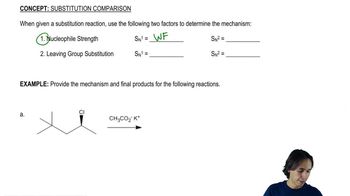
How do we predict if the mechanism is SN1 or SN2?

Substitution Products

The expected substitution product in nucleophilic reactions depends on the nature of the nucleophile and the substrate. For example, when a strong nucleophile reacts with a primary alkyl halide, an SN2 mechanism typically yields a single product. In contrast, with a tertiary alkyl halide and a weak nucleophile, an SN1 mechanism may lead to a racemic mixture of products due to the formation of a planar carbocation.
Recommended video:
Guided course
11:07
Bridged-Products
Related Practice
Textbook Question

Propose a mechanism involving a hydride shift or an alkyl shift for each solvolysis reaction. Explain how each rearrangement forms a more stable intermediate.

Hint: Most rearrangements convert 2° (or incipient 1°) carbocations to 3° or resonance-stabilized carbocations.

(b)

1
views
Textbook Question

Under certain conditions, when (R)-2-bromobutane is heated with water, the SN1 substitution proceeds twice as fast as the SN2. Calculate the e.e. and the specific rotation expected for the product. The specific rotation of (R)-butan-2-ol is −13.5°. Assume that the SN1 gives equal amounts of the two enantiomers.

1
views
Textbook Question

For each reaction, give the expected substitution product, and predict whether the ­mechanism will be predominantly first order (SN1) or second order (SN2).

d. cyclohexylbromide + methanol

e. cyclohexylbromide + sodium ethoxide

1
views
Textbook Question

Propose a mechanism involving a hydride shift or an alkyl shift for each solvolysis reaction. Explain how each rearrangement forms a more stable intermediate.

Hint: Most rearrangements convert 2° (or incipient 1°) carbocations to 3° or resonance-stabilized carbocations.

(c)

3
views
Textbook Question

Propose a mechanism involving a hydride shift or an alkyl shift for each solvolysis reaction. Explain how each rearrangement forms a more stable intermediate.

Hint: Most rearrangements convert 2° (or incipient 1°) carbocations to 3° or resonance-stabilized carbocations.

(d)

1
views
Textbook Question

For each reaction, give the expected substitution product, and predict whether the ­mechanism will be predominantly first order (SN1) or second order (SN2).

c. 1-iodo-1-methylcyclohexane + ethanol

2
views