
Ch.6 - Alkyl Halides; Nucleophilic Substitution
Wade - Organic Chemistry 9th Edition
Wade9th EditionOrganic ChemistryISBN: 9780135213728Not the one you use?Change textbook
Chapter 6, Problem 6b

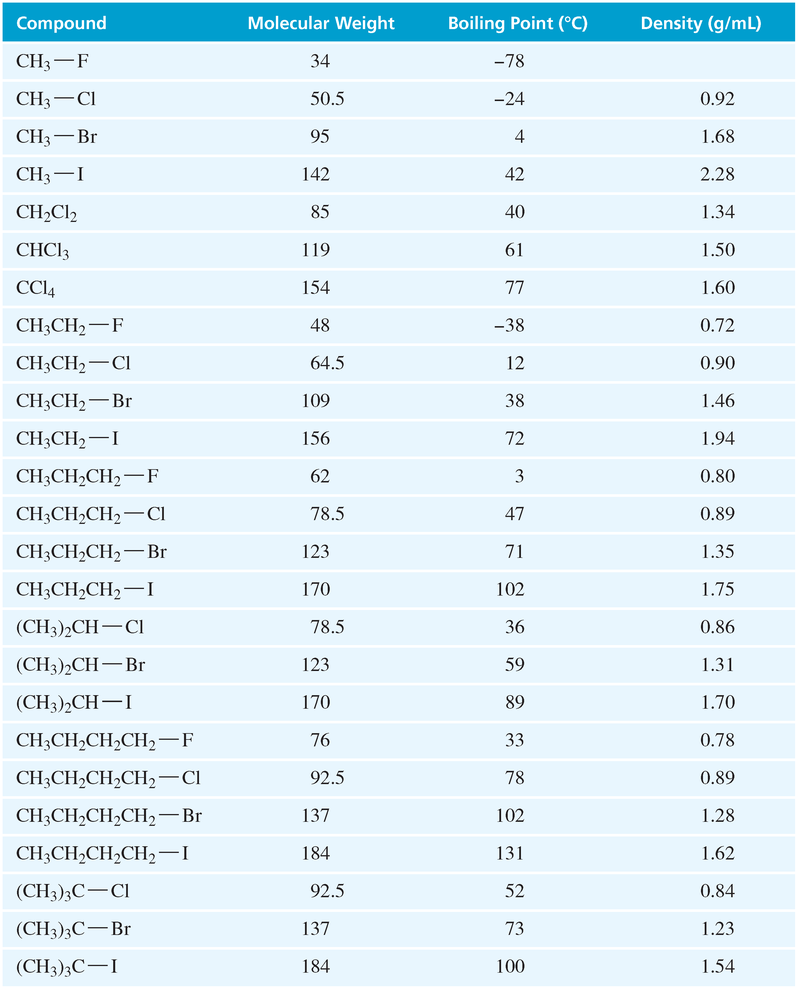
For each pair of compounds, predict which compound has the higher boiling point. Check [TABLE 6-2] to see if your prediction was right; then explain why that compound has the higher boiling point.
b. isopropyl chloride and tert-butyl bromide

Verified step by step guidance
1
Identify the functional groups and molecular structures of each compound. Isopropyl chloride is an alkyl halide with a chlorine atom attached to an isopropyl group, while tert-butyl bromide is an alkyl halide with a bromine atom attached to a tert-butyl group.
Consider the molecular weight of each compound. Bromine is heavier than chlorine, which generally contributes to a higher boiling point due to increased van der Waals forces.
Evaluate the branching in the carbon chain. Tert-butyl bromide has more branching compared to isopropyl chloride, which can affect boiling point by reducing surface area and intermolecular forces.
Analyze the electronegativity and polarizability of the halogens. Bromine is less electronegative but more polarizable than chlorine, which can lead to stronger intermolecular forces and a higher boiling point.
Compare the intermolecular forces present in each compound. Consider dipole-dipole interactions and van der Waals forces, which are influenced by the size and polarizability of the halogen atoms.

Verified video answer for a similar problem:

This video solution was recommended by our tutors as helpful for the problem above.
Video duration:
2m
Was this helpful?

Key Concepts

Here are the essential concepts you must grasp in order to answer the question correctly.

Intermolecular Forces

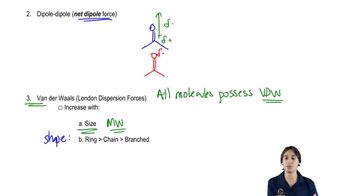
Intermolecular forces are the forces that hold molecules together, affecting properties like boiling points. The stronger the intermolecular forces, such as hydrogen bonding, dipole-dipole interactions, and van der Waals forces, the higher the boiling point. In this context, understanding the type and strength of these forces in isopropyl chloride and tert-butyl bromide is crucial.
Recommended video:
Guided course
03:01
How Van der Waals forces work.

Molecular Structure and Polarity

The molecular structure and polarity of a compound influence its boiling point. Polar molecules, which have uneven distribution of electron density, typically exhibit stronger dipole-dipole interactions, leading to higher boiling points. Analyzing the structure of isopropyl chloride and tert-butyl bromide helps determine their polarity and predict boiling points.
Recommended video:
Guided course
2:04
Molecular Polarity

Halogen Influence on Boiling Point

Halogens, such as chlorine and bromine, impact boiling points due to their size and electronegativity. Bromine, being larger and less electronegative than chlorine, can lead to stronger van der Waals forces in tert-butyl bromide compared to isopropyl chloride. This concept helps explain why tert-butyl bromide might have a higher boiling point.
Recommended video:
Guided course
03:08
How IMFs are related to melting and boiling points.
Related Practice
Textbook Question

a. Propose a mechanism for the following reaction:

b. Use the bond-dissociation enthalpies given in Table 4-2 (page 167) to calculate the value of ΔH° for each step shown in your mechanism. (The BDE for CH2=CHCH2―Br is about 280 kJ/mol, or 67 kcal/mol.) Calculate the overall value of ΔH° for the reaction. Are these values consistent with a rapid free-radical chain reaction?

1
views
Textbook Question

For each pair of compounds, predict which compound has the higher boiling point. Check [TABLE 6-2] to see if your prediction was right; then explain why that compound has the higher boiling point.

c. 1-bromobutane and 1-chlorobutane

1
views
Textbook Question

Show how you might use SN2 reactions to convert 1-chlorobutane into the following compounds.

a. butan-1-ol

4
views
Textbook Question

Show how you might use SN2 reactions to convert 1-chlorobutane into the following compounds.

b. 1-fluorobutane

6
views
Textbook Question

The light-initiated reaction of 2,3-dimethylbut-2-ene with N-bromosuccinimide (NBS) gives two products:

a. Give a mechanism for this reaction, showing how the two products arise as a ­consequence of the resonance-stabilized intermediate.

1
views
Textbook Question

Under appropriate conditions, (S)-1-bromo-1-fluoroethane reacts with sodium methoxide to give pure (S)-1-fluoro-1-methoxyethane.

a. Why is bromide rather than fluoride replaced?

b. Draw perspective structures (as shown on the previous page for 2-bromobutane) for the starting material, the transition state, and the product.

c. Does the product show retention or inversion of configuration? d. Is this result consistent with reaction by the SN2 mechanism?

1
views