Ch.9 - Alkynes
Wade - Organic Chemistry 9th Edition
Wade9th EditionOrganic ChemistryISBN: 9780135213728Not the one you use?Change textbook
Chapter 9, Problem 42b

Using any necessary inorganic reagents, show how you would convert acetylene and isobutyl bromide to
(b) (±)-2,7-dimethyloctane-4,5-diol.

Verified step by step guidance
1
Step 1: Begin by converting acetylene (C₂H₂) into a terminal alkyne. This can be achieved by reacting acetylene with sodium amide (NaNH₂) in liquid ammonia (NH₃) to generate the acetylide ion (C≡C⁻). Then, react the acetylide ion with methyl iodide (CH₃I) to form propyne (CH₃C≡CH).
Step 2: Perform a hydroboration-oxidation reaction on propyne to convert the terminal alkyne into an aldehyde. Use disiamylborane (Sia₂BH) for selective hydroboration, followed by oxidation with hydrogen peroxide (H₂O₂) in the presence of sodium hydroxide (NaOH). This yields propanal (CH₃CH₂CHO).
Step 3: React isobutyl bromide ((CH₃)₂CHCH₂Br) with magnesium (Mg) in dry ether to form the corresponding Grignard reagent, isobutylmagnesium bromide ((CH₃)₂CHCH₂MgBr). Then, perform a nucleophilic addition reaction between the Grignard reagent and propanal to form a secondary alcohol, 2,7-dimethylheptanol.
Step 4: Oxidize the secondary alcohol to a ketone using an oxidizing agent such as pyridinium chlorochromate (PCC). This converts 2,7-dimethylheptanol into 2,7-dimethylheptan-4-one.
Step 5: Perform a stereoselective reduction of the ketone using a reducing agent like sodium borohydride (NaBH₄) or lithium aluminum hydride (LiAlH₄) to yield (±)-2,7-dimethyloctane-4,5-diol. This reduction introduces two hydroxyl groups at the 4 and 5 positions, completing the synthesis.

Verified video answer for a similar problem:

This video solution was recommended by our tutors as helpful for the problem above.
Video duration:
4m
Was this helpful?

Key Concepts

Here are the essential concepts you must grasp in order to answer the question correctly.

Alkyne Reactivity

Acetylene is a simple alkyne that can undergo various reactions, including hydrogenation, halogenation, and nucleophilic addition. Understanding the reactivity of alkynes is crucial for predicting the products of reactions involving acetylene, especially when forming more complex molecules like alcohols or diols.
Recommended video:
Guided course
09:11
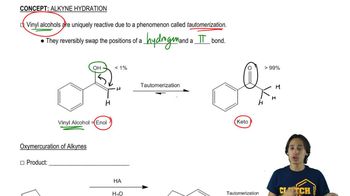
Alkyne Hydration

Nucleophilic Substitution

Isobutyl bromide is a primary alkyl halide that can participate in nucleophilic substitution reactions. In these reactions, a nucleophile attacks the carbon atom bonded to the bromine, leading to the replacement of the bromine atom. This concept is essential for understanding how to introduce new functional groups into organic molecules.
Recommended video:
Guided course
01:47
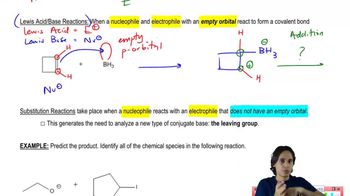
Nucleophiles and Electrophiles can react in Substitution Reactions.

Stereochemistry of Alcohols

The formation of (±)-2,7-dimethyloctane-4,5-diol involves the introduction of hydroxyl groups at specific positions on the carbon chain. Understanding stereochemistry is vital, as it determines the spatial arrangement of atoms in the molecule, which can affect the compound's properties and reactivity. The term (±) indicates a racemic mixture, highlighting the importance of chirality in organic synthesis.
Recommended video:
1:38
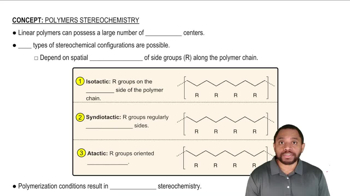
Polymer Stereochemistry Concept 1
Related Practice
Textbook Question

The following functional-group interchange is a useful synthesis of aldehydes.

(c) Explain why a nucleophilic reagent such as ethoxide adds to an alkyne more easily than it adds to an alkene.

7
views

Textbook Question

Deduce the structure of each compound from the information given. All unknowns in this problem have molecular formula C8H12.

(a) Upon catalytic hydrogenation, unknown W gives cyclooctane. Ozonolysis of W, followed by reduction with dimethyl sulfide, gives octanedioic acid, HOOC–(CH2)6–COOH. Draw the structure of W.

6
views
Textbook Question

The following functional-group interchange is a useful synthesis of aldehydes.

(a) What reagents were used in this chapter for this transformation? Give an example to illustrate this method.

(b) This functional-group interchange can also be accomplished using the following sequence.

Propose mechanisms for these steps.

3
views
Textbook Question

Deduce the structure of each compound from the information given. All unknowns in this problem have molecular formula C8H12.

(c) Upon catalytic hydrogenation, unknown Y gives cyclooctane. Ozonolysis of Y, followed by reduction with dimethyl sulfide, gives a three-carbon dialdehyde and a five-carbon dialdehyde. Draw the structure of Y.

(d) Upon catalytic hydrogenation, unknown Z gives cis-bicyclo[4.2.0]octane. Ozonolysis of Z, followed by reduction with dimethyl sulfide, gives a cyclobutane with a three-carbon aldehyde (–CH2–CH2–CHO) group on C1 and a one-carbon aldehyde (–CHO) group on C2. Draw the structure of Z.

4
views
Textbook Question

Using any necessary inorganic reagents, show how you would convert acetylene and isobutyl bromide to

(a) meso-2,7-dimethyloctane-4,5-diol, (CH3)2CHCH2CH(OH)CH(OH)CH2CH(CH3)2.

1
views