Ch.9 - Alkynes
Wade - Organic Chemistry 9th Edition
Wade9th EditionOrganic ChemistryISBN: 9780135213728Not the one you use?Change textbook
Chapter 9, Problem 23d

Predict the product(s) you would expect from treatment of each compound with (1) dilute, neutral KMnO4 and (2) warm basic KMnO4, then dilute acid.
(d) 2-methylhex-3-yne

Verified step by step guidance
1
Step 1: Understand the reactivity of the alkyne (2-methylhex-3-yne) with KMnO4. Neutral KMnO4 (dilute) is a mild oxidizing agent that adds hydroxyl groups across the triple bond, forming a diol. Warm, basic KMnO4 followed by acid is a stronger oxidizing agent that cleaves the triple bond, producing carboxylic acids.
Step 2: For reaction with dilute, neutral KMnO4, identify the triple bond in 2-methylhex-3-yne. The triple bond is between carbons 3 and 4. Neutral KMnO4 will add hydroxyl groups (-OH) to both carbons of the triple bond, resulting in a vicinal diol (a compound with two hydroxyl groups on adjacent carbons).
Step 3: For reaction with warm, basic KMnO4 followed by acid, the triple bond undergoes oxidative cleavage. This means the triple bond is broken, and each carbon of the triple bond is oxidized to a carboxylic acid. Identify the groups attached to carbons 3 and 4 to determine the resulting carboxylic acids.
Step 4: Analyze the structure of 2-methylhex-3-yne. Carbon 3 is bonded to a methyl group and a hydrogen, while carbon 4 is bonded to a propyl group and a hydrogen. Upon oxidative cleavage, carbon 3 will form acetic acid (CH3COOH), and carbon 4 will form butanoic acid (CH3CH2CH2COOH).
Step 5: Summarize the products. For dilute, neutral KMnO4, the product is a vicinal diol. For warm, basic KMnO4 followed by acid, the products are acetic acid and butanoic acid. Ensure to draw the structures of the products for clarity.

Verified video answer for a similar problem:

This video solution was recommended by our tutors as helpful for the problem above.
Video duration:
5m
Was this helpful?

Key Concepts

Here are the essential concepts you must grasp in order to answer the question correctly.

Oxidation Reactions

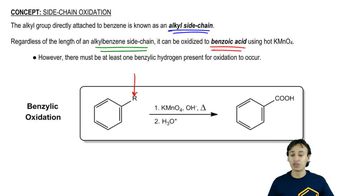
Oxidation reactions involve the loss of electrons or an increase in oxidation state by a molecule. In organic chemistry, these reactions often lead to the formation of alcohols, ketones, or carboxylic acids. Understanding how different oxidizing agents, like KMnO4, interact with various functional groups is crucial for predicting the products of these reactions.
Recommended video:
Guided course
03:20
Benzylic Oxidation

KMnO4 as an Oxidizing Agent

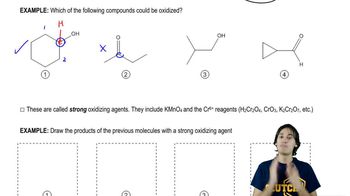
Potassium permanganate (KMnO4) is a strong oxidizing agent used in organic synthesis. In dilute, neutral conditions, it typically oxidizes alkynes to form cis-diol products, while in warm basic conditions followed by acid treatment, it can cleave alkynes to yield carboxylic acids. Recognizing the conditions under which KMnO4 operates helps in predicting the outcome of reactions.
Recommended video:
Guided course
03:40
Strong oxidizing agents

Alkyne Reactivity

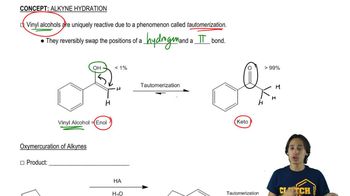
Alkynes, characterized by carbon-carbon triple bonds, exhibit unique reactivity patterns compared to alkenes and alkanes. They can undergo various reactions, including oxidation, which can lead to the formation of different functional groups. Understanding the structure and reactivity of 2-methylhex-3-yne is essential for predicting the products when treated with KMnO4.
Recommended video:
Guided course
09:11
Alkyne Hydration