
Ch.9 - Alkynes
Wade - Organic Chemistry 9th Edition
Wade9th EditionOrganic ChemistryISBN: 9780135213728Not the one you use?Change textbook
Chapter 9, Problem 33d,e,f

Predict the products of reaction of pent-1-yne with the following reagents.
d. H2, Pd/BaSO4, quinoline
e. 1 equivalent of Br2
f. 2 equivalents of Br2

Verified step by step guidance
1
Step 1: Understand the reaction in part (d). The reagents H2, Pd/BaSO4, and quinoline represent a Lindlar catalyst. This catalyst is used for the partial hydrogenation of alkynes to cis-alkenes. Pent-1-yne will undergo partial hydrogenation to form cis-pent-1-ene.
Step 2: For part (e), consider the reaction of pent-1-yne with 1 equivalent of Br2. Bromine (Br2) adds to the triple bond of the alkyne in an anti-addition manner, forming a trans-dibromoalkene. The product will be trans-1,2-dibromopent-1-ene.
Step 3: For part (f), analyze the reaction of pent-1-yne with 2 equivalents of Br2. In this case, the alkyne undergoes two successive additions of bromine. The first equivalent adds to form a dibromoalkene, and the second equivalent adds to the double bond, resulting in a tetrabromoalkane. The final product will be 1,1,2,2-tetrabromopentane.
Step 4: Summarize the stereochemistry and regiochemistry of the products. For part (d), the product is a cis-alkene due to the Lindlar catalyst. For part (e), the product is a trans-dibromoalkene due to anti-addition. For part (f), the product is a fully saturated tetrabromoalkane with no stereochemistry concerns.
Step 5: Verify the reaction conditions and ensure the reagents are used correctly. Lindlar catalyst selectively stops at the alkene stage, while bromine reacts in a stepwise manner depending on the equivalents used. This ensures the predicted products align with the given reagents.

Verified video answer for a similar problem:

This video solution was recommended by our tutors as helpful for the problem above.
Video duration:
7m
Was this helpful?

Key Concepts

Here are the essential concepts you must grasp in order to answer the question correctly.

Hydrogenation

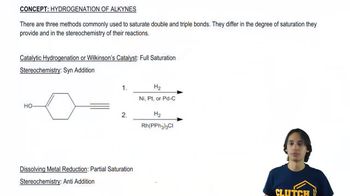
Hydrogenation is a chemical reaction that involves the addition of hydrogen (H2) to an unsaturated compound, such as an alkyne or alkene, in the presence of a catalyst. In this case, using H2 with Pd/BaSO4 and quinoline selectively reduces pent-1-yne to a cis-alkene, due to the catalyst's ability to facilitate the addition of hydrogen across the triple bond without fully saturating it.
Recommended video:
Guided course
00:48
The definition of hydrogenation.

Electrophilic Addition of Bromine

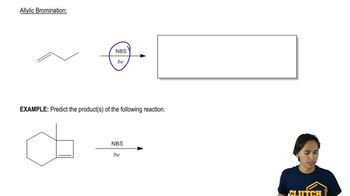
The electrophilic addition of bromine (Br2) to alkenes and alkynes involves the formation of a cyclic bromonium ion intermediate, which leads to the addition of bromine across the double or triple bond. When one equivalent of Br2 reacts with pent-1-yne, it results in the formation of a dibrominated alkene, while two equivalents of Br2 will fully saturate the triple bond, yielding a vicinal dibromide.
Recommended video:
Guided course
00:54
Mechanism of Allylic Bromination.

Regioselectivity and Stereochemistry

Regioselectivity refers to the preference of a chemical reaction to yield one structural isomer over others, while stereochemistry deals with the spatial arrangement of atoms in molecules. In the case of bromination, the regioselectivity will determine which carbon atoms of pent-1-yne are brominated, and the stereochemistry will influence whether the resulting dibromide is formed as a cis or trans isomer, depending on the reaction conditions.
Recommended video:
1:38
Polymer Stereochemistry Concept 1