Ch.9 - Alkynes
Wade - Organic Chemistry 9th Edition
Wade9th EditionOrganic ChemistryISBN: 9780135213728Not the one you use?Change textbook
Chapter 9, Problem 27c,d

Give common names for the following compounds.
(c) 3-methyloct-4-yne
(d) (CH3)3C–C≡C–CH(CH3)CH2CH3

Verified step by step guidance
1
Step 1: Understand the structure of the compound 3-methyloct-4-yne. The name indicates that it is an alkyne with a total of eight carbon atoms (oct) and a triple bond starting at the fourth carbon (4-yne). Additionally, there is a methyl group attached to the third carbon (3-methyl).
Step 2: Draw the structure of the compound based on the IUPAC name. Start by drawing a straight chain of eight carbon atoms. Then, add a triple bond between the fourth and fifth carbon atoms. Finally, attach a methyl group to the third carbon atom.
Step 3: Identify the longest continuous carbon chain that includes the triple bond. In this case, the longest chain is the octane chain with the triple bond, which is the main chain.
Step 4: Determine the common name by considering the substituents and the position of the triple bond. The common naming system often uses the name of the substituent followed by the name of the main chain, with the position of the triple bond indicated.
Step 5: Combine the substituent name with the main chain name to form the common name. The methyl group is at the third position, and the triple bond starts at the fourth position, so the common name will reflect these positions in relation to the main chain.

Verified video answer for a similar problem:

This video solution was recommended by our tutors as helpful for the problem above.
Video duration:
6m
Was this helpful?

Key Concepts

Here are the essential concepts you must grasp in order to answer the question correctly.

IUPAC Nomenclature

IUPAC nomenclature is a systematic method of naming organic chemical compounds as recommended by the International Union of Pure and Applied Chemistry. It provides a standard way to name compounds, ensuring that each name is unique and descriptive of the compound's structure. Understanding IUPAC rules is essential for converting systematic names to common names.
Recommended video:
Guided course
03:43
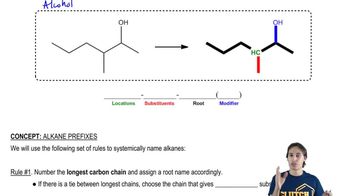
The different parts of an IUPAC name

Common Names in Organic Chemistry

Common names are traditional names for chemical compounds that are often derived from the source of the compound or its properties. Unlike IUPAC names, common names do not follow a systematic structure and can vary widely. Familiarity with common names is important for recognizing compounds in literature and industry.
Recommended video:
Guided course
02:01
Introducing common solvents and other molecules in organic chemistry.

Alkynes

Alkynes are hydrocarbons that contain at least one carbon-carbon triple bond, characterized by the suffix '-yne' in IUPAC nomenclature. They are unsaturated compounds with the general formula CnH2n-2. Understanding the structure and properties of alkynes is crucial for identifying and naming them, both systematically and commonly.
Recommended video:
Guided course
09:11
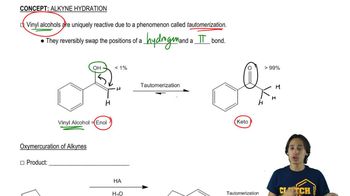
Alkyne Hydration