Ch.9 - Alkynes
Wade - Organic Chemistry 9th Edition
Wade9th EditionOrganic ChemistryISBN: 9780135213728Not the one you use?Change textbook
Chapter 9, Problem 25b

Develop syntheses for the following compounds, using acetylene and compounds containing no more than four carbon atoms as your organic starting materials.
(b) cis-1-ethyl-2-methylcyclopropane

Verified step by step guidance
1
Start by recognizing that the target molecule, cis-1-ethyl-2-methylcyclopropane, is a cyclopropane derivative with specific substituents in a cis configuration. The synthesis will involve forming the cyclopropane ring and introducing the substituents in the correct stereochemistry.
Use acetylene as the starting material. Acetylene can be converted into ethylene (C₂H₄) through hydrogenation using a Lindlar catalyst to stop at the alkene stage. This ethylene will serve as a precursor for further reactions.
To introduce the ethyl group, perform a hydroboration-oxidation reaction on ethylene to form ethanol (C₂H₅OH). Then, convert ethanol into ethyl bromide (C₂H₅Br) using phosphorus tribromide (PBr₃). This ethyl bromide will be used as an alkylating agent.
To form the cyclopropane ring, use a Simmons-Smith reaction. React a suitable alkene (e.g., propene, which can be synthesized from acetylene) with diiodomethane (CH₂I₂) and a zinc-copper couple to generate the cyclopropane ring. Ensure that the substituents are introduced in a way that maintains the cis configuration.
Finally, introduce the methyl group at the appropriate position on the cyclopropane ring. This can be achieved by using a methylating agent, such as methyl iodide (CH₃I), in the presence of a strong base. Verify that the stereochemistry of the product is cis by considering the reaction conditions and mechanisms.

Verified video answer for a similar problem:

This video solution was recommended by our tutors as helpful for the problem above.
Video duration:
10m
Was this helpful?

Key Concepts

Here are the essential concepts you must grasp in order to answer the question correctly.

Acetylene as a Building Block

Acetylene (C2H2) is a simple alkyne that serves as a versatile building block in organic synthesis. Its triple bond allows for various reactions, including addition reactions with electrophiles, which can lead to the formation of larger carbon frameworks. Understanding how to manipulate acetylene is crucial for constructing complex molecules from simpler precursors.
Recommended video:
Guided course
16:59
Building a molecular sentence

Cyclopropane Structure and Reactivity

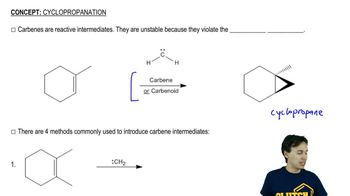
Cyclopropane is a three-membered carbon ring known for its unique angle strain due to the 60-degree bond angles. This strain makes cyclopropane and its derivatives reactive, allowing for ring-opening reactions and the formation of substituted cyclopropanes. Recognizing how to synthesize and modify cyclopropane derivatives is essential for creating compounds like cis-1-ethyl-2-methylcyclopropane.
Recommended video:
Guided course
01:49
General properties of cyclopropanation.

Stereochemistry in Organic Synthesis

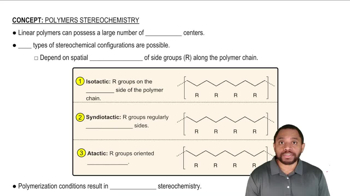
Stereochemistry refers to the spatial arrangement of atoms in molecules and is critical in organic synthesis, especially for compounds with multiple stereocenters. The cis- and trans- configurations can significantly affect the properties and reactivity of a compound. Understanding stereochemical principles is vital for accurately synthesizing and characterizing compounds like cis-1-ethyl-2-methylcyclopropane.
Recommended video:
1:38
Polymer Stereochemistry Concept 1