Ch.8 - Reactions of Alkenes
Wade - Organic Chemistry 9th Edition
Wade9th EditionOrganic ChemistryISBN: 9780135213728Not the one you use?Change textbook
Chapter 8, Problem 16b

When 1,2-dimethylcyclopentene undergoes hydroboration–oxidation, one diastereomer of the product predominates. Show why this addition is stereospecific, and predict the stereochemistry of the major product.

Verified step by step guidance
1
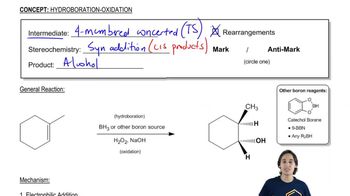
Understand the reaction: Hydroboration–oxidation is a two-step reaction. In the first step, borane (BH₃ or a derivative) adds to the alkene in a syn addition, meaning both the boron and hydrogen add to the same face of the double bond. In the second step, oxidation with hydrogen peroxide (H₂O₂) and hydroxide (OH⁻) replaces the boron with a hydroxyl group (-OH). This reaction follows anti-Markovnikov regioselectivity, meaning the -OH group ends up on the less substituted carbon of the double bond.
Analyze the structure of 1,2-dimethylcyclopentene: The double bond in 1,2-dimethylcyclopentene is between two carbons in a cyclopentane ring, with methyl groups attached to the 1 and 2 positions. The steric hindrance caused by the methyl groups will influence the approach of the borane reagent.
Determine the stereospecificity of the hydroboration step: The borane adds to the double bond in a syn fashion, meaning both the boron and hydrogen add to the same face of the cyclopentene ring. The steric hindrance from the methyl groups will favor one face of the double bond for the addition, leading to a specific diastereomer.
Predict the stereochemistry of the oxidation step: During the oxidation step, the boron atom is replaced by a hydroxyl group (-OH) without altering the stereochemistry established in the hydroboration step. This means the -OH group and the hydrogen added in the first step will remain on the same face of the ring.
Conclude the stereochemistry of the major product: The major product will have the hydroxyl group and the hydrogen added to the same face of the cyclopentane ring, resulting in a specific diastereomer. The stereochemistry is determined by the steric hindrance of the methyl groups, which directs the addition to the less hindered face of the double bond.

Verified video answer for a similar problem:

This video solution was recommended by our tutors as helpful for the problem above.
Video duration:
4m
Was this helpful?

Key Concepts

Here are the essential concepts you must grasp in order to answer the question correctly.

Hydroboration-Oxidation

Hydroboration-oxidation is a two-step reaction that converts alkenes into alcohols. In the first step, borane (BH3) adds across the double bond of the alkene in a syn addition, resulting in the formation of an organoborane intermediate. The second step involves oxidation with hydrogen peroxide (H2O2) and a base, converting the boron to a hydroxyl group. This process is stereospecific, meaning it leads to a specific stereochemical outcome based on the geometry of the starting alkene.
Recommended video:
Guided course
06:38
General properties of hydroboration-oxidation.

Stereospecificity

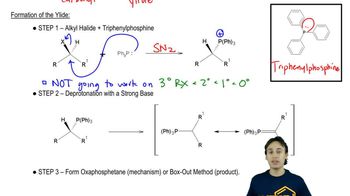
Stereospecificity refers to a reaction where the stereochemistry of the reactant determines the stereochemistry of the product. In the case of hydroboration-oxidation, the syn addition of borane to the alkene ensures that both substituents are added to the same side of the double bond. This results in a specific diastereomer being formed, as the spatial arrangement of the substituents in the product is directly influenced by the configuration of the starting material.
Recommended video:
Guided course
15:39
Box-Out Method and Full-Mechanism

Diastereomers

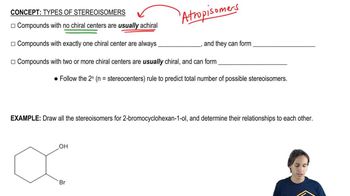
Diastereomers are stereoisomers that are not mirror images of each other and have different physical properties. In the context of the hydroboration-oxidation of 1,2-dimethylcyclopentene, the reaction can yield multiple diastereomers due to the different spatial arrangements of the substituents. The predominance of one diastereomer over another can be predicted based on steric factors and the mechanism of the reaction, which favors the formation of the more stable product.
Recommended video:
Guided course
03:44
Using chiral centers to predict types of stereoisomers.