Ch.8 - Reactions of Alkenes
Wade - Organic Chemistry 9th Edition
Wade9th EditionOrganic ChemistryISBN: 9780135213728Not the one you use?Change textbook
Chapter 8, Problem 50i

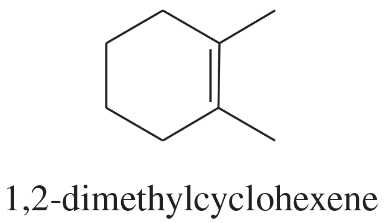
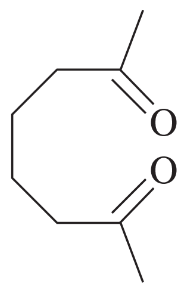
Using 1,2-dimethylcyclohexene as your starting material, show how you would synthesize the following compounds. (Once you have shown how to synthesize a compound, you may use it as the starting material in any later parts of this problem.) If a chiral product is shown, assume that it is part of a racemic mixture.

(i)

Verified step by step guidance
1
Step 1: Analyze the starting material, 1,2-dimethylcyclohexene. It is a cyclohexene ring with two methyl groups attached to the 1 and 2 positions. The double bond is located between the 1 and 2 carbons.
Step 2: Identify the target compound. The target structure is a diketone with two ketone groups at the 1 and 2 positions of the cyclohexane ring. This suggests oxidative cleavage of the double bond in the starting material.
Step 3: Select an appropriate reagent for oxidative cleavage. Use a strong oxidizing agent such as potassium permanganate (KMnO₄) or ozone (O₃) followed by reductive workup (e.g., zinc and acetic acid) to cleave the double bond and form the diketone.
Step 4: Perform the reaction. Treat 1,2-dimethylcyclohexene with ozone (O₃) in the presence of a solvent like dichloromethane, followed by reductive workup using zinc and acetic acid. This will cleave the double bond and oxidize the carbons to ketones.
Step 5: Verify the product. The resulting compound should be the desired diketone with two ketone groups at the 1 and 2 positions of the cyclohexane ring, matching the target structure.

Verified video answer for a similar problem:

This video solution was recommended by our tutors as helpful for the problem above.
Video duration:
3m
Was this helpful?

Key Concepts

Here are the essential concepts you must grasp in order to answer the question correctly.

Synthesis Reactions

Synthesis reactions in organic chemistry involve the transformation of starting materials into more complex products through various chemical reactions. Understanding the mechanisms and conditions required for these reactions is crucial for predicting the outcomes and identifying the necessary reagents. In this context, synthesizing compounds from 1,2-dimethylcyclohexene requires knowledge of functional group transformations and reaction pathways.
Recommended video:
1:16
Synthesis of Amino Acids: Strecker Synthesis Example 1

Ozonolysis

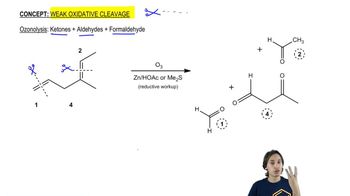
Ozonolysis is a reaction involving the cleavage of alkenes using ozone (O3), resulting in the formation of carbonyl compounds such as aldehydes or ketones. This reaction is particularly useful for breaking double bonds and generating new functional groups. In the context of the question, ozonolysis can be applied to 1,2-dimethylcyclohexene to produce specific products that can be further transformed in subsequent synthesis steps.
Recommended video:
Guided course
06:30
General properties of ozonolysis.

Chirality and Racemic Mixtures

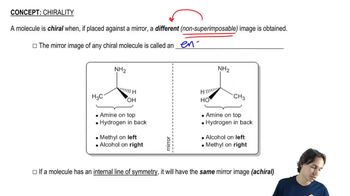
Chirality refers to the property of a molecule that makes it non-superimposable on its mirror image, often resulting in two enantiomers. A racemic mixture contains equal amounts of both enantiomers, leading to no optical activity. Understanding chirality is essential when synthesizing compounds that may exhibit stereochemistry, as it affects the properties and reactivity of the products derived from 1,2-dimethylcyclohexene.
Recommended video:
Guided course
05:10
What is chirality?