
Textbook Question
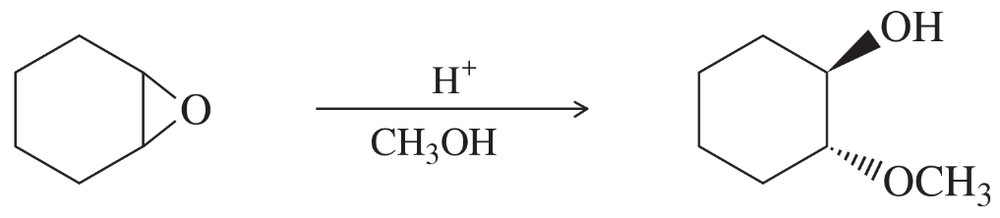
Propose mechanisms consistent with the following reactions.
(d)
2
views

 Verified step by step guidance
 09:23
09:23
 04:20
04:20 06:23
06:23Propose mechanisms consistent with the following reactions.
(d)
Cyclohexene is dissolved in a solution of lithium chloride in chloroform. To this solution is added one equivalent of bromine. The material isolated from this reaction contains primarily a mixture of trans-1,2-dibromocyclohexane and trans-1-bromo-2-chlorocyclohexane. Propose a mechanism to show how these compounds are formed.
Propose mechanisms consistent with the following reactions.
(c)
Propose mechanisms consistent with the following reactions.
(f)
Draw an approximate reaction-energy diagram showing the curves for the two possible pathways for ionic addition of HBr to 1-methylcyclohexene. (a) Formation of the major product, 1-bromo-1-methylcyclohexane, and (b) formation of the minor product, 1-bromo-2-methylcyclohexane. Point out how these curves show that 1-bromo-1-methylcyclohexane should be formed faster.
Unknown X, C5H9Br does not react with bromine or with dilute KMnO4. Upon treatment with potassium tert-butoxide, X gives only one product, Y, C5H8. Unlike X, Y decolorizes bromine and changes KMnO4 from purple to brown. Catalytic hydrogenation of Y gives methylcyclobutane. Ozonolysis–reduction of Y gives dialdehyde Z, C5H8O2. Propose consistent structures for X, Y, and Z. Is there any aspect of the structure of X that is still unknown?