
Ch.8 - Reactions of Alkenes
Wade - Organic Chemistry 9th Edition
Wade9th EditionOrganic ChemistryISBN: 9780135213728Not the one you use?Change textbook
Chapter 8, Problem 64

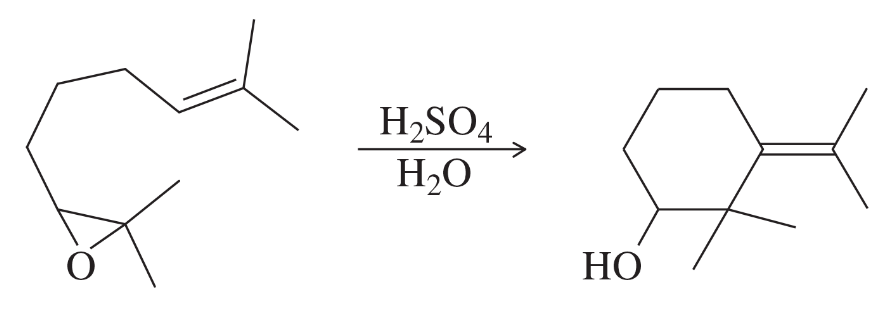
Propose a mechanism for the following reaction.

Verified step by step guidance
1
Step 1: Protonation of the epoxide ring. The reaction begins with the acid catalyst (H2SO4) protonating the oxygen atom of the epoxide ring, making it more electrophilic and susceptible to nucleophilic attack.
Step 2: Ring opening of the epoxide. Water (H2O) acts as a nucleophile and attacks the more substituted carbon of the epoxide ring, leading to the opening of the ring and forming a carbocation intermediate.
Step 3: Carbocation rearrangement. The carbocation formed undergoes rearrangement to stabilize itself. This involves a hydride shift or alkyl shift to form a more stable tertiary carbocation.
Step 4: Deprotonation to form the alcohol. A water molecule removes a proton from the intermediate, resulting in the formation of the alcohol group at the site of the carbocation.
Step 5: Formation of the final product. The double bond is retained in the structure, and the final product is formed with the hydroxyl group and the alkene in the correct positions as shown in the product structure.

Verified video answer for a similar problem:

This video solution was recommended by our tutors as helpful for the problem above.
Video duration:
5m
Was this helpful?

Key Concepts

Here are the essential concepts you must grasp in order to answer the question correctly.

Acid-Catalyzed Hydration

Acid-catalyzed hydration is a reaction where water adds to an alkene in the presence of an acid, typically sulfuric acid (H2SO4). The acid protonates the alkene, forming a more stable carbocation intermediate, which then reacts with water to form an alcohol. This mechanism is crucial for understanding how alkenes can be converted into alcohols through hydration.
Recommended video:
Guided course
06:34
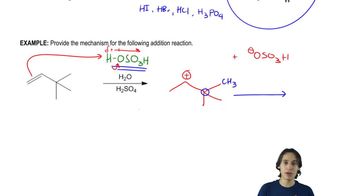
Acid-catalyzed hydration mechanism

Carbocation Stability

Carbocation stability is a key concept in organic chemistry that refers to the relative stability of positively charged carbon species. Carbocations are stabilized by alkyl groups through hyperconjugation and inductive effects. Understanding the stability of different carbocations helps predict the major products of reactions involving carbocation intermediates, such as in the hydration of alkenes.
Recommended video:
Guided course
05:58
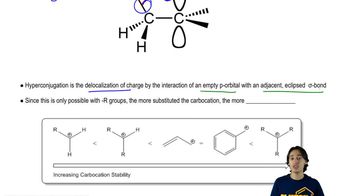
Determining Carbocation Stability

Markovnikov's Rule

Markovnikov's Rule states that in the addition of HX to an alkene, the hydrogen atom will attach to the carbon with the greater number of hydrogen atoms already attached, while the halide (or hydroxyl group in hydration) will attach to the carbon with fewer hydrogen atoms. This rule helps predict the regioselectivity of reactions involving alkenes, guiding the formation of the more stable product.
Recommended video:
Guided course
03:54
The 18 and 16 Electron Rule
Related Practice
Textbook Question

The two butenedioic acids are called fumaric acid (trans) and maleic acid (cis). 2,3-Dihydroxybutanedioic acid is called tartaric acid.

Show how you would convert

a. fumaric acid to (±)-tartaric acid.

b. fumaric acid to meso-tartaric acid.

1
views
Textbook Question

One of the constituents of turpentine is α-pinene, formula C10H6. The following scheme (called a “road map”) gives some reactions of α-pinene. Determine the structure of α-pinene and of the reaction products of A through E.

1
views
Textbook Question

In contact with a platinum catalyst, an unknown alkene reacts with three equivalents of hydrogen gas to give 1-isopropyl-4-methylcyclohexane. When the unknown alkene is ozonized and reduced, the products are the following:

Deduce the structure of the unknown alkene.

2
views
Textbook Question

The two butenedioic acids are called fumaric acid (trans) and maleic acid (cis). 2,3-Dihydroxybutanedioic acid is called tartaric acid.

Show how you would convert

c. maleic acid to (±)-tartaric acid.

2
views
Textbook Question

The two butenedioic acids are called fumaric acid (trans) and maleic acid (cis). 2,3-Dihydroxybutanedioic acid is called tartaric acid.

Show how you would convert

b. fumaric acid to meso-tartaric acid.

1
views
Textbook Question

The sex attractant of the housefly has the formula C23H46. When treated with warm potassium permanganate, this pheromone gives two products: CH3(CH2)12COOH and CH3(CH2)7COOH. Suggest a structure for this sex attractant. Explain which part of the structure is uncertain.

1
views