Ch.8 - Reactions of Alkenes
Wade - Organic Chemistry 9th Edition
Wade9th EditionOrganic ChemistryISBN: 9780135213728Not the one you use?Change textbook
Chapter 8, Problem 34f

Predict the major products of the following reactions, including stereochemistry.
f. trans-pent-2-ene + peroxyacetic acid in water

Verified step by step guidance
1
Identify the type of reaction: The reaction involves trans-pent-2-ene (an alkene) and peroxyacetic acid in water. This is an epoxidation reaction followed by hydrolysis, which forms a diol (glycol).
Understand the mechanism: Peroxyacetic acid reacts with the alkene to form an epoxide (a three-membered cyclic ether). The stereochemistry of the starting alkene (trans) will influence the stereochemistry of the epoxide.
Determine the stereochemistry of the epoxide: Since the starting alkene is trans-pent-2-ene, the substituents on the epoxide will also be trans due to the concerted nature of the epoxidation reaction.
Account for the hydrolysis step: In the presence of water, the epoxide undergoes acid-catalyzed ring opening to form a diol. The attack of water on the epoxide occurs anti to the leaving group, leading to anti stereochemistry in the diol.
Predict the final product: The major product will be a trans-1,2-diol (anti addition of hydroxyl groups) due to the stereochemical outcome of the epoxidation and subsequent hydrolysis steps.

Verified video answer for a similar problem:

This video solution was recommended by our tutors as helpful for the problem above.
Video duration:
2m
Was this helpful?

Key Concepts

Here are the essential concepts you must grasp in order to answer the question correctly.

Electrophilic Addition Reactions

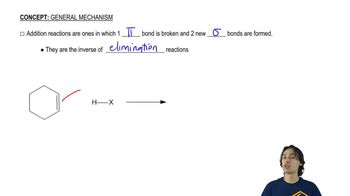
Electrophilic addition reactions involve the addition of an electrophile to a nucleophile, typically across a double bond. In the case of alkenes like trans-pent-2-ene, the π bond is broken, allowing for the formation of new σ bonds with the electrophile and nucleophile. Understanding this mechanism is crucial for predicting the products of reactions involving alkenes.
Recommended video:
Guided course
05:39
Features of Addition Mechanisms.

Stereochemistry

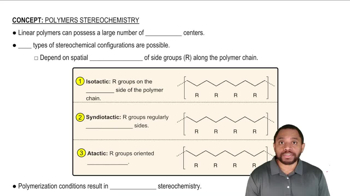
Stereochemistry refers to the study of the spatial arrangement of atoms in molecules and how this affects their chemical behavior. In reactions involving alkenes, the stereochemistry of the starting material can influence the stereochemical outcome of the products. For trans-pent-2-ene, recognizing the configuration of the double bond is essential for predicting the stereochemical products formed during the reaction.
Recommended video:
1:38
Polymer Stereochemistry Concept 1

Peracid Reactions

Peracids, such as peroxyacetic acid, are strong oxidizing agents that can react with alkenes to form epoxides or other oxidized products. The reaction typically involves the formation of a cyclic intermediate, which can lead to various products depending on the conditions and the structure of the alkene. Understanding how peracids interact with alkenes is key to predicting the major products of the given reaction.
Recommended video:
Guided course
05:09
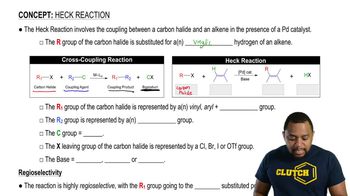
Heck Reaction