Ch.8 - Reactions of Alkenes
Wade - Organic Chemistry 9th Edition
Wade9th EditionOrganic ChemistryISBN: 9780135213728Not the one you use?Change textbook
Chapter 8, Problem 46c

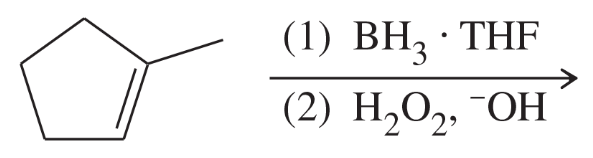
Predict the major products of the following reactions, and give the structures of any intermediates. Include stereochemistry where appropriate.
(c)

Verified step by step guidance
1
Step 1: Recognize the reaction type. This is a hydroboration-oxidation reaction, which converts an alkene into an alcohol. The reaction proceeds via anti-Markovnikov addition, meaning the hydroxyl group (-OH) will attach to the less substituted carbon of the double bond.
Step 2: Analyze the starting material. The molecule is a cyclopentene with a methyl group attached to one of the carbons in the double bond. The double bond is the reactive site in this reaction.
Step 3: Describe the first step of the reaction. In the presence of BH₃·THF, the boron atom adds to the less substituted carbon of the double bond, while the hydrogen adds to the more substituted carbon. This step forms an organoborane intermediate.
Step 4: Describe the second step of the reaction. The organoborane intermediate reacts with hydrogen peroxide (H₂O₂) and hydroxide ions (HO⁻) to replace the boron atom with a hydroxyl group (-OH). This step completes the anti-Markovnikov addition of water across the double bond.
Step 5: Consider stereochemistry. Hydroboration-oxidation proceeds with syn addition, meaning the hydrogen and hydroxyl group will add to the same face of the cyclopentane ring. This stereochemistry should be reflected in the final product structure.

Verified video answer for a similar problem:

This video solution was recommended by our tutors as helpful for the problem above.
Video duration:
5m
Was this helpful?

Key Concepts

Here are the essential concepts you must grasp in order to answer the question correctly.

Hydroboration-Oxidation

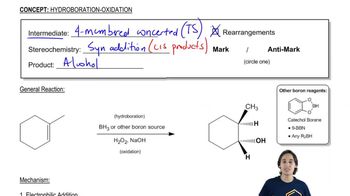
Hydroboration-oxidation is a two-step reaction process used to convert alkenes into alcohols. In the first step, borane (BH3) adds across the double bond of the alkene, forming a trialkylborane intermediate. The second step involves oxidation with hydrogen peroxide (H2O2) and hydroxide ion (OH-), which replaces the boron with a hydroxyl group, yielding an alcohol.
Recommended video:
Guided course
06:38
General properties of hydroboration-oxidation.

Stereochemistry

Stereochemistry refers to the study of the spatial arrangement of atoms in molecules and how this affects their chemical behavior. In reactions like hydroboration-oxidation, the stereochemistry of the product is important, as the addition of borane occurs in a syn fashion, leading to specific stereochemical outcomes in the final alcohol product.
Recommended video:
1:38
Polymer Stereochemistry Concept 1

Regioselectivity

Regioselectivity is the preference of a chemical reaction to yield one structural isomer over others when multiple products are possible. In the hydroboration-oxidation of alkenes, the reaction is regioselective, typically favoring the formation of the more stable alcohol, which is determined by the position of the double bond and the steric and electronic effects of substituents.
Recommended video:
Guided course
05:09
Heck Reaction