Ch.8 - Reactions of Alkenes
Wade - Organic Chemistry 9th Edition
Wade9th EditionOrganic ChemistryISBN: 9780135213728Not the one you use?Change textbook
Chapter 8, Problem 2b

When 1-chlorocyclohexene reacts with HBr, the major product is 1-bromo-1-chlorocyclohexane. Propose a mechanism for this reaction, and explain why your proposed intermediate is more stable than the other possible intermediate

Verified step by step guidance
1
Step 1: Begin by identifying the reactants and the type of reaction. The reactants are 1-chlorocyclohexene and HBr, and the reaction involves electrophilic addition of HBr to the double bond in the cyclohexene ring.
Step 2: The first step in the mechanism is protonation of the double bond. The π-electrons of the double bond attack the hydrogen atom of HBr, forming a carbocation intermediate. Use MathML to represent the protonation step: `CH2(CH)=CH(CH)`.
Step 3: Consider the stability of the carbocation intermediate. The protonation can lead to two possible carbocations: a secondary carbocation at the 2-position or a tertiary carbocation at the 1-position. The tertiary carbocation is more stable due to hyperconjugation and inductive effects from the adjacent chlorine atom, which stabilizes the positive charge.
Step 4: The bromide ion (Br⁻) generated in the first step now acts as a nucleophile and attacks the more stable tertiary carbocation. This results in the formation of the major product, 1-bromo-1-chlorocyclohexane.
Step 5: Summarize why the tertiary carbocation intermediate is favored. The chlorine atom at the 1-position exerts an inductive electron-withdrawing effect, stabilizing the positive charge on the carbocation. Additionally, tertiary carbocations are inherently more stable than secondary carbocations due to hyperconjugation and the distribution of charge.

Verified video answer for a similar problem:

This video solution was recommended by our tutors as helpful for the problem above.
Video duration:
2m
Was this helpful?

Key Concepts

Here are the essential concepts you must grasp in order to answer the question correctly.

Electrophilic Addition Mechanism

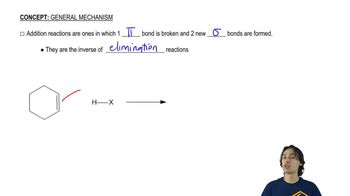
The reaction of 1-chlorocyclohexene with HBr follows an electrophilic addition mechanism, where the double bond acts as a nucleophile, attacking the electrophilic hydrogen in HBr. This results in the formation of a carbocation intermediate. Understanding this mechanism is crucial as it sets the stage for the subsequent steps leading to the final product.
Recommended video:
Guided course
05:39
Features of Addition Mechanisms.

Carbocation Stability

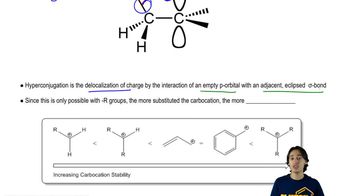
Carbocation stability is a key factor in determining the major product of electrophilic addition reactions. Carbocations can be classified as primary, secondary, or tertiary based on the number of alkyl groups attached to the positively charged carbon. Tertiary carbocations are the most stable due to hyperconjugation and inductive effects, which help to stabilize the positive charge.
Recommended video:
Guided course
05:58
Determining Carbocation Stability

Regioselectivity

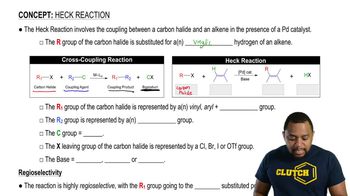
Regioselectivity refers to the preference of a chemical reaction to yield one structural isomer over others. In the case of the reaction between 1-chlorocyclohexene and HBr, the formation of 1-bromo-1-chlorocyclohexane is favored due to the stability of the carbocation intermediate formed during the reaction. This concept is essential for predicting the major product in electrophilic addition reactions.
Recommended video:
Guided course
05:09
Heck Reaction