Ch.8 - Reactions of Alkenes
Wade - Organic Chemistry 9th Edition
Wade9th EditionOrganic ChemistryISBN: 9780135213728Not the one you use?Change textbook
Chapter 8, Problem 38

a. Propose a mechanism for the following reaction.
2 (CH3)2C=CH–CH3 + cat. H+ → 2,3,4,4-tetramethylhex-2-ene
b. Show the first three steps (as far as the tetramer) in the BF3–catalyzed polymerization of propylene to form polypropylene.

Verified step by step guidance
1
Step 1: For part (a), begin by identifying the reaction type. The reaction involves the acid-catalyzed dimerization of 2-methyl-2-pentene ((CH3)2C=CH-CH3). The mechanism starts with protonation of the double bond by the acid catalyst (H+), forming a carbocation intermediate. Write the protonation step as: (CH3)2C=CH-CH3+H+(CH3)2C-CH-CH3+.
Step 2: The carbocation formed in step 1 undergoes a nucleophilic attack by another molecule of 2-methyl-2-pentene. This forms a new bond between the two molecules, resulting in a larger carbocation intermediate. Represent this step as: (CH3)2C-CH-CH3++(CH3)2C=CH-CH3(CH3)2C-CH-C(CH3)2-CH3+.
Step 3: The carbocation intermediate formed in step 2 undergoes deprotonation to form the final product, 2,3,4,4-tetramethylhex-2-ene. This step involves the removal of a proton from the carbocation, restoring the double bond. Write this step as: (CH3)2C-CH-C(CH3)2-CH3+(CH3)2C=C(CH3)2-CH3.
Step 4: For part (b), the BF3-catalyzed polymerization of propylene begins with the formation of a complex between BF3 and propylene. BF3 acts as a Lewis acid, accepting electrons from the double bond of propylene to form a carbocation intermediate. Represent this step as: CH2=CHCH3+BF3CH2-CHCH3+.
Step 5: The carbocation formed in step 4 reacts with another molecule of propylene, initiating chain growth. This forms a larger carbocation intermediate. Represent this step as: CH2-CHCH3++CH2=CHCH3CH2-CHCH3-CH2-CHCH3+.

Verified video answer for a similar problem:

This video solution was recommended by our tutors as helpful for the problem above.
Video duration:
4m
Was this helpful?

Key Concepts

Here are the essential concepts you must grasp in order to answer the question correctly.

Reaction Mechanism

A reaction mechanism is a step-by-step description of the process by which reactants are converted into products. It outlines the individual steps, including bond breaking and formation, and the intermediates formed during the reaction. Understanding mechanisms is crucial for predicting the outcome of chemical reactions and for designing new synthetic pathways.
Recommended video:
Guided course
02:16
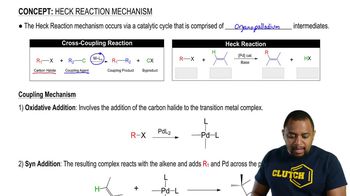
Heck Reaction Mechanism

Catalysis

Catalysis involves the acceleration of a chemical reaction by a substance called a catalyst, which is not consumed in the reaction. In the context of the given question, H+ and BF3 serve as catalysts that facilitate the reactions without altering their own chemical structure. Catalysts lower the activation energy required for reactions, making them proceed more rapidly and efficiently.
Recommended video:
2:31
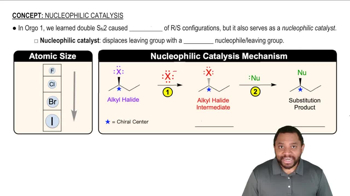
Nucleophilic Catalysis Concept 1

Polymerization

Polymerization is the process by which small molecules, known as monomers, chemically bond to form a larger, more complex structure called a polymer. In the case of propylene, the polymerization process involves the formation of long chains through repeated addition reactions. Understanding the steps of polymerization is essential for predicting the properties and applications of the resulting polymer, such as polypropylene.
Recommended video:
1:06
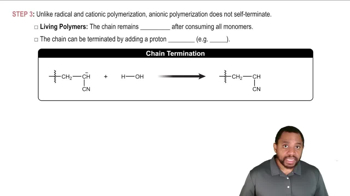
Anionic Polymerization Concept 4