Ch.8 - Reactions of Alkenes
Wade - Organic Chemistry 9th Edition
Wade9th EditionOrganic ChemistryISBN: 9780135213728Not the one you use?Change textbook
Chapter 8, Problem 30

a. Propose a mechanism for the conversion of cis-hex-3-ene to the epoxide (3,4-­epoxyhexane) and the ring-opening reaction to give the glycol, hexane-3,4-diol. In your mechanism, pay particular attention to the stereochemistry of the intermediates and products.
b. Repeat part (a) for trans-hex-3-ene. Compare the products obtained from cis- and trans-hex-3-ene. Is this reaction sequence stereospecific?

Verified step by step guidance
1
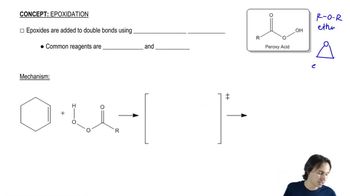
Step 1: **Epoxidation of cis-hex-3-ene**: Begin by identifying the reagent used for epoxidation. Typically, a peracid such as m-chloroperbenzoic acid (mCPBA) is used. The reaction proceeds via a concerted mechanism where the π-electrons of the alkene interact with the peracid, forming a three-membered epoxide ring. For cis-hex-3-ene, the stereochemistry of the starting alkene ensures that the substituents on the epoxide will remain cis to each other.
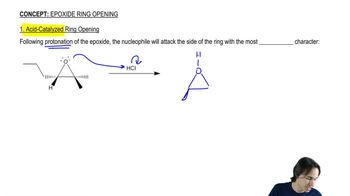
Step 2: **Ring-opening of the epoxide (cis-3,4-epoxyhexane)**: The epoxide can be opened under acidic or basic conditions. In acidic conditions, a proton (H⁺) first protonates the oxygen atom of the epoxide, making it more electrophilic. A nucleophile, such as water (H₂O), then attacks the more substituted carbon of the epoxide (Markovnikov regioselectivity), leading to the formation of a glycol (hexane-3,4-diol). The stereochemistry of the product will reflect the anti-addition mechanism of the ring-opening step.
Step 3: **Epoxidation of trans-hex-3-ene**: Repeat the epoxidation process for trans-hex-3-ene using mCPBA. The stereochemistry of the starting alkene ensures that the substituents on the epoxide will remain trans to each other. This is due to the concerted nature of the epoxidation reaction, which preserves the relative stereochemistry of the alkene.
Step 4: **Ring-opening of the epoxide (trans-3,4-epoxyhexane)**: Under acidic conditions, the epoxide is protonated, and water attacks the more substituted carbon. The anti-addition mechanism ensures that the resulting glycol (hexane-3,4-diol) will have substituents that are trans to each other. This contrasts with the cis-hex-3-ene case, where the glycol substituents are cis.
Step 5: **Comparison and stereospecificity**: Compare the products obtained from cis- and trans-hex-3-ene. The cis-alkene leads to a cis-glycol, while the trans-alkene leads to a trans-glycol. This demonstrates that the reaction sequence is stereospecific, as the stereochemistry of the starting alkene determines the stereochemistry of the final product.

Verified video answer for a similar problem:

This video solution was recommended by our tutors as helpful for the problem above.
Video duration:
5m
Was this helpful?

Key Concepts

Here are the essential concepts you must grasp in order to answer the question correctly.

Epoxidation

Epoxidation is a chemical reaction that converts alkenes into epoxides, which are three-membered cyclic ethers. This reaction typically involves the addition of an oxidizing agent, such as peracids, to the double bond of the alkene. The stereochemistry of the starting alkene influences the stereochemistry of the resulting epoxide, making it crucial to consider when proposing mechanisms.
Recommended video:
Guided course
02:19
General properties of epoxidation.

Stereochemistry

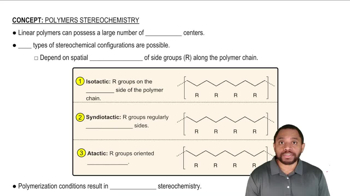
Stereochemistry refers to the study of the spatial arrangement of atoms in molecules and how this affects their chemical behavior. In the context of the question, understanding the stereochemistry of intermediates and products is essential, as it determines the configuration of the epoxide and the resulting glycol. The stereochemical outcome can vary significantly between cis and trans isomers, impacting the final product's properties.
Recommended video:
1:38
Polymer Stereochemistry Concept 1

Ring-Opening Reactions

Ring-opening reactions involve the cleavage of a cyclic compound, such as an epoxide, to form a more stable product, often resulting in diols. The mechanism can be influenced by the presence of nucleophiles and the stereochemistry of the epoxide. In this case, the ring-opening of the epoxide formed from cis- and trans-hex-3-ene will yield different stereochemical outcomes, highlighting the importance of understanding reaction pathways and stereospecificity.
Recommended video:
Guided course
04:34
Acid-Catalyzed Epoxide Ring-Opening