Ch. 7 - Structure and Synthesis of Alkenes; Elimination
Wade - Organic Chemistry 9th Edition
Wade9th EditionOrganic ChemistryISBN: 9780135213728Not the one you use?Change textbook
Chapter 7, Problem 73

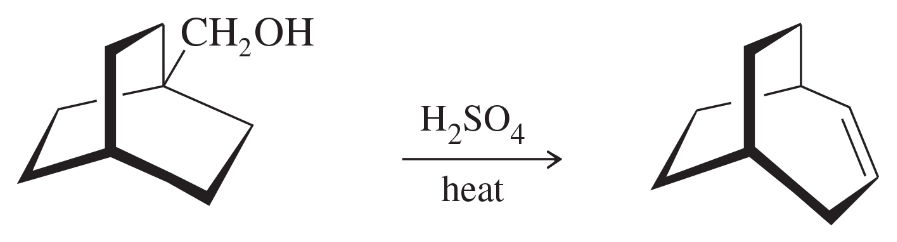
Write a mechanism that explains the formation of the following product. In your mechanism, explain the cause of the rearrangement, and explain the failure to form the Zaitsev product.

Verified step by step guidance
1
Step 1: Protonation of the alcohol group - The reaction begins with the protonation of the hydroxyl group (-OH) on the CH2OH substituent by sulfuric acid (H2SO4). This forms a good leaving group, water (H2O), and converts the alcohol into a positively charged intermediate.
Step 2: Formation of a carbocation - The water molecule leaves, resulting in the formation of a carbocation at the CH2 position. This carbocation is initially a primary carbocation, which is unstable.
Step 3: Carbocation rearrangement - To stabilize the carbocation, a hydride shift occurs. A hydrogen atom from the adjacent bridgehead carbon migrates to the carbocation center, resulting in a more stable tertiary carbocation. This rearrangement is driven by the increased stability of tertiary carbocations compared to primary carbocations.
Step 4: Elimination reaction - Under the influence of heat, a β-hydrogen is removed from the tertiary carbocation, leading to the formation of a double bond. The elimination follows the E1 mechanism, where the leaving group departs first, followed by the elimination of the β-hydrogen.
Step 5: Explanation of product formation - The product formed is not the Zaitsev product because the steric constraints of the bicyclic structure favor the formation of the less substituted alkene. The bulky nature of the bicyclic system prevents the formation of the more substituted double bond, which would typically be favored in Zaitsev's rule.

Verified video answer for a similar problem:

This video solution was recommended by our tutors as helpful for the problem above.
Video duration:
8m
Was this helpful?

Key Concepts

Here are the essential concepts you must grasp in order to answer the question correctly.

Elimination Reactions

Elimination reactions involve the removal of atoms or groups from a molecule, resulting in the formation of a double bond. In organic chemistry, these reactions can follow either an E1 or E2 mechanism, depending on the conditions and the structure of the substrate. Understanding the type of elimination is crucial for predicting the products formed, including the possibility of rearrangements.
Recommended video:
Guided course
00:40
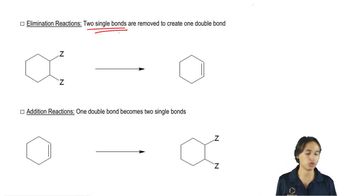
Recognizing Elimination Reactions.

Zaitsev's Rule

Zaitsev's Rule states that in elimination reactions, the more substituted alkene (the more stable product) is typically favored. This is due to the stability of the alkene formed, as more substituted alkenes have lower energy and are more thermodynamically stable. However, certain conditions, such as steric hindrance or the presence of strong bases, can lead to the formation of less substituted products instead.
Recommended video:
Guided course
01:18
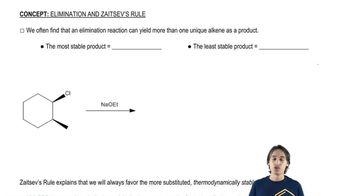
Defining Zaitsev’s Rule

Carbocation Rearrangement

Carbocation rearrangement occurs when a carbocation intermediate shifts to a more stable configuration during a reaction. This can involve hydride shifts or alkyl shifts, leading to the formation of a more stable carbocation. Understanding this concept is essential for predicting the outcome of reactions, especially when explaining why a particular product is formed instead of the expected Zaitsev product.
Recommended video:
Guided course
00:47
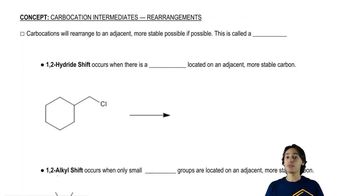
Understanding why carbocations shift.
Related Practice
Textbook Question

Explain the dramatic difference in rotational energy barriers of the following three alkenes. (Hint: Consider what the transition states must look like.)

2
views

Textbook Question

One of the following dichloronorbornanes undergoes elimination much faster than the other. Determine which one reacts faster, and explain the large difference in rates.

1
views
Textbook Question

The following reaction is called the pinacol rearrangement. The reaction begins with an acid-promoted ionization to give a carbocation. This carbocation undergoes a methyl shift to give a more stable, resonance-stabilized cation. Loss of a proton gives the observed product. Propose a mechanism for the pinacol rearrangement.

2
views
Textbook Question

Deuterium (D) is the isotope of hydrogen of mass number 2, with a proton and a neutron in its nucleus. The chemistry of deuterium is nearly identical to the chemistry of hydrogen, except that the C―D bond is slightly (5.0 kJ/mol, or 1.2 kcal/mol) stronger than the C―H bond. Reaction rates tend to be slower if a C―D bond (as opposed to a C―H bond) is broken in a rate-limiting step. This effect on the rate is called a kinetic isotope effect. (Review Problem 4-57)

b. When the following deuterated compound reacts under the same conditions, the rate of formation of the substitution product is unchanged, while the rate of formation of the elimination product is slowed by a factor of 7.

Explain why the elimination rate is slower, but the substitution rate is unchanged.

5
views
Textbook Question

Deuterium (D) is the isotope of hydrogen of mass number 2, with a proton and a neutron in its nucleus. The chemistry of deuterium is nearly identical to the chemistry of hydrogen, except that the C―D bond is slightly (5.0 kJ/mol, or 1.2 kcal/mol) stronger than the C―H bond. Reaction rates tend to be slower if a C―D bond (as opposed to a C―H bond) is broken in a rate-limiting step. This effect on the rate is called a kinetic isotope effect. (Review PROBLEM 4-57)

a. Propose a mechanism to explain each product in the following reaction.

1
views
Textbook Question

When 2-bromo-3-phenylbutane is treated with sodium methoxide, two alkenes result (by E2 elimination). The Zaitsev product predominates.

b. When one pure stereoisomer of 2-bromo-3-phenylbutane reacts, one pure stereoisomer of the major product results. For example, when (2R,3R)-2-bromo-3-phenylbutane reacts, the product is the stereoisomer with the methyl groups cis. Use your models to draw a Newman projection of the transition state to show why this stereospecificity is observed.

c. Use a Newman projection of the transition state to predict the major product of elimination of (2S,3R)-2-bromo-3-phenylbutane.

d. Predict the major product from elimination of (2S,3S)-2-bromo-3-phenylbutane. This prediction can be made without drawing any structures, by considering the results in part (b).

7
views